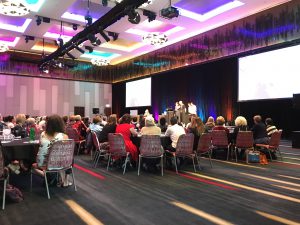
Strengtheningmidwifery education standardsto improve maternity serviceswas the call at the recent Trans-Tasman Midwifery Education conference.
Hosted by Griffith’s School of Nursing and Midwifery, the conference was held on the Gold Coast from 20-21 September and had the aim of“Transforming Midwifery Practice through Education”.
“It is important that midwifery education standards are shaped to drive best policy and practice, and the engagement of the profession through the consortium and conference is key to enabling this outcome,” said keynote speakerProfessor Mary Renfrew.
A professor of Mother and Infant Health at the University of Dundee, Professor Renfrew is a midwife, health researcher and educator and has previously worked in the Universities of York, Leeds and Oxford.
“Midwifery is a vital solution to the challenges of providing high quality maternal and newborn care for all women and infants in all countries,” she told conference delegates.
Prior to the session, Professor Renfrew also visited the Logan Community Maternity Hubs which was established early this year.
“I met some tremendous practitioners working together to build a service that really meets the needs of women and babies,” she said. “I talked with women and families and could see that there were lots of challenges – deprivation, culture, complex clinical needs, and social problems.”
Other presentations at the conference included one by Professor Roianne West who spoke about “ClosingtheGap with transformative Indigenous Midwifery Education and Practice”.
Professor West told delegates that totruly transformmidwifery practice through education and close the gap in health outcomes betweenAboriginal and Torres Strait Islander mothers and babies and other mothers and babies, we need tobecome more sophisticated in integrating Aboriginal Health philosophy and education philosophy.
To this end she proposed an integration oftransformative decolonisinglearning theories within acultural safety educational model.
Caitlin Pearson never intended to work in the charity or not-for-profit sector but her time at Griffith University played a big part in changing her philosophy.
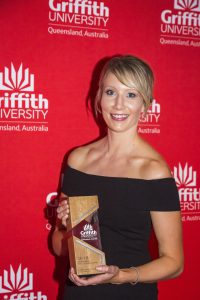
The General Manager of Marketing and Engagement at Macarthur Disability Services (MDS) is the winner of Griffith Business Schools Young Alumnus of the Year Award for 2018, and she says she is where she is today because of her time at the University.
“It’s really interesting, looking back now and I can definitely see the volunteering I was encouraged to do while at Griffith University has probably sparked that interest in doing volunteer work and getting involved at a community level,” she explains. “And I think then that sort of pushed me in this direction towards working in the charity and not-for-profit space.”
In addition to her work for MDS, Caitlin is heavily involved with charities in general, which she says is extremely important to her on both a personal and professional level. “I volunteer on a lot of charity boards, and I do a bit of work with the local council around accessibility and inclusion of people with disabilities, too.
“And I do think that’s all linked back to previous experience I had in volunteering at Griffith. It’s made me have some sort of internal feel-good connection that I wanted to continue to explore!”
Caitlin Pearson.
A typical day working for MDS— an organisation supporting more than 1000 people with disabilities and/or mental health issues, including their carers and families— sees Caitlin overseeing the planning of internal and external events and functions to raise much needed funds for the cause. “No two days are the same,” she says. “And I really feel like I am making a difference… I know that’s a cliche thing to say but I go to some of the events that I organise and I stand back and I think, “Wow there are 500 people here that are having an amazing day and an amazing experience and my work contributed to that.
“It’s really powerful, you feel like you’ve done something really worthwhile.”
In addition to her GBS Young Alumnus of the Year Award for 2018, Caitlin was also recently named CEO Magazine’s Not For Profit Executive of the Year Award in recognition of her sponsorship and branding strategy which led to MDS boosting their fundraising revenue by 50 per cent.
Having worked her way up from Junior Events Planner to General Manager of Marketing and Engagement, the Bachelor of Business graduate says many of the experiences she had while at Griffith have shaped the way she does business.
“I picked Griffith because I was really interested in a lot of the extracurricular activities and programs they had… while I was there I got to do a lot of their internships and work experience.
“I was also involved with the Honours College as well and they also pushed a lot of volunteering opportunities my way, which became really important to me.
“Already academically Griffith is amazing, but it’s those things such as the Honours College that set it apart. You get the opportunity to practise your public speaking and build your confidence and networking skills… they’re all things I use on a daily basis in my job now,” she explains.
She continues: “Whenever I tell people I studied at Griffith they are always so impressed! I’m proud to have gone to a uni with such a good reputation. I also follow what other students from Griffith are doing and I am proud to see their achievements; it’s nice to be in this big family of students that are going out and doing awesome things in the world.”
Caitlin says she was really shocked and thrilled to win the GBS Outstanding Young Alumnus Award. “I guess for me it is an acknowledgement that the work I am doing is important and valued and people see that when they see the contribution I am making to my local community. So yeah for me that’s a nice little pat on the back.”
Mr Burgess said he was honoured to be recognised by the Australian Council of University Art and Design. The national awardfollows a Griffith Award for Excellence in Teaching.
“I’ve spent the past five years working on this project, and it feels great to receive validation that you’re on the right track,” he said.
“I also think this award honours the approach we take at Griffith Film School, which is to offer our students these partnerships and industry experiences.”
Industry experience
Mr Burgess advocates experiential learning, and has structured his course to replicate the experience of being on a film set.
“We throw the students in at the deep end, and they are transformed by the end of the two weeks – their whole perspective on filmmaking changes,” he said.
“They are learning by doing and are totally immersed in the experience.”
A gifted and dedicated teacher
Head of Griffith Film School Professor Herman Van Eyken said the awardacknowledged Mr Burgess’s innovative approach to course design and delivery.
“He is a gifted and dedicated teacher and this award is well-deserved,” he said.
“The strength of Ashley’s contribution is not just in his natural leadership or innovative course designs, but in his capacity to tailor his approach and methods to achieve the best learning outcomes for students.
“His courses are consistently described by students as ‘amazing’, ‘transformative’ and ‘invaluable’.
“Based on the success of his course in outback Queensland and the model he has developed, Ashley now runs similar programs in India, Thailand and Vanuatu, where our students make documentaries and engage heavily with local communities.”
Mr Burgess is currently helping design a Masters in International Screen Production in partnership with other top film schools in the Asia-Pacific region, using the Outback Filmmaking Bootcamps as a model.
Griffith Film School animation alumni have created a hit new series for the ABC and BBC Worldwide, providing work for scores of young animation graduates in Brisbane.
Bluey, which follows the adventures of an adorable Blue Heeler pup, premiered onABC Kids this week.
Griffith Film School alumnus Joe Brumm, who worked on BAFTA-award winning kids show Charlie and Lola, created Bluey after watching his daughters at play.
“It’s fascinating seeing how much they learn from devising and playing their own games. Bluey is a celebration of the role imaginative play has in shaping healthy kids,” he said.
As creator and showrunner, Joe wanted to ground the universal themes of family and fun in a recognisably Australian setting.
“We are making this series right here in Brisbane with local animators and actors, so I wanted that reflected on screen- we’ve included Queenslanders, hilly suburban streets, backyard swimming pools,” he said.
Joe graduated in 1998 with a Bachelor of Animation (Honours) and worked in London for a decade before returning home and establishing his own production company, Studio Joho.
For Bluey, Joe teamed up with Ludo Studio – co-founded in 2012 by fellow Griffith Film School alumnus Daley Pearson, who helped create the Emmy-award winning kids series Doodles.
Ludo’s ethos is simple: ‘create locally, screen globally’. This is evident in the amount of local talent working behind the scenes – including more than 20 Griffith Film School animation graduates.
Daley, who is Executive Producer on Bluey, said the team had done an “fantastic job”.
“Joe and more than 40 Queensland animators, designers, sound and production talent are doing an incredible job,” he said.
“These artists have taken everything beautiful about Brisbane and put it on the screen to make a truly Australian show.”
Bachelor of Animation graduate Beth Harvey is one of the lead animators on the project and said the series was one of several animation hits produced in Brisbane.
“I hope that this helps put Brisbane on the world map for animation,” she said.
Both Beth and fellow Griffith animation graduate Claire Renton had to move to London to find work when they graduated.
“I think a lot of animators get used to having to move and go where the work is, so to have it happen in your home town … it’s really great,” Ms Renton said.
“On the job experience is key, and on a production like this you get to have a taste of everything.”
“Fifty per cent of people employed on this project are new graduates from Griffith Film School,” he said.
“For a long time there were only a couple of animation studios in Brisbane, but there has been a real upsurge in the industry, with a dedicated children’s channel on the ABC and streaming services like Netflix and Stan.
“The course at GFS attracts people who have a genuine desire to go into this industry, and they are surrounded by other people who feel the same.
“It’s a bonus that people can stay in Brisbane and find meaningful work in the industry.”
Bluey is currently screening on ABC KIDS and ABC KIDS iview, followed by international broadcast on BBC.
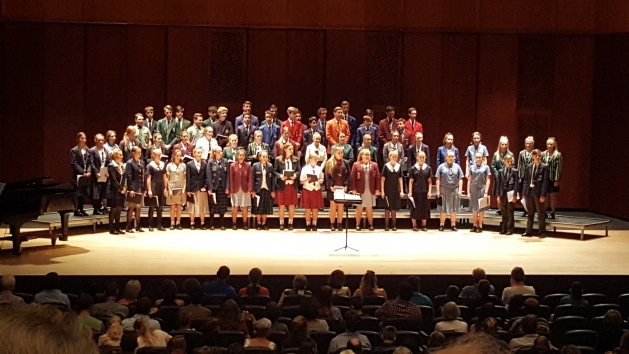
More than 900 high school music students have travelledfrom the Border to the Cape and as far west as Mt Isa for four days of intensive rehearsals, tutorials and concerts at Griffith’s South Bank campus.
A further 130 students from NSW, Victoria and the ACT were selected to participate in the inaugural Australian Honours Ensemble Program and15 American college students will represent the prestigious Pacific Honours Ensemble Program (PHEP).
Leading music educators from the UK, US and Australia will oversee a range of ensembles, from big bands and orchestras to a Celtic string ensemble and choirs.
On Sunday 7 October, more than 3,000 people are expected to visit the Conservatorium’s South Bank campus for a series of five grand finale concerts.
Queensland Conservatorium Director Professor Scott Harrison said the program had grown from modest beginnings to a record number of students attending this year.
“This is our largest ever cohort with many more nominations received from schools than we were able to accommodate,” he said.
“It is a delight to welcome hundreds of emerging musicians to our state-of-the-art facilities at South Bank.
“SHEP is now a firmly established aspect of music education in Queensland, bringing together young people from across the state to share their passion for music.”
This weekend’s event is one of eight SHEP programs held throughout Queensland each year — the remaining seven workshops take place in regional Queensland.
The grand finale concerts will be held on Sunday 7 October at 10am, noon, 2pm, 4pm and 7pm.
For more information, contact Lisa Dart at [email protected] or 3735 6375.
Professor Stephen Billett
Could Vocational Education and Training (VET) hold the answer to the global problem of youth unemployment?
“The image of VET is often quite low in many countries including those with advanced industrial economies as well as those with developing economies.
“Outcomes of low image include a reluctance of young people and their parents to consider VET as a viable educational option, viewing participation in it as a second option as best.”
Professor Billett has recently returned from Beirut where he facilitated a workshop for UNESCO on VET in middle eastern countries. He also moderated a virtual conference with 346 participants from 82 countries for UNESCO-UNEVOC: an organisation with a sole focus on vocational education..
“The conference provided opportunities for participants to share perspectives and information about the image of VET and to offer suggestions on how that image could be enhanced in their countries, and elsewhere to make VET more attractive to young people,” he said.
“Low image of VET can lead to reduced government, industry and enterprise sponsorship and support of VET, thereby adding to its unattractiveness for young people.
“Yet, paradoxically, in many countries there is a growing shortage of skilled workers to meet the requirements of enterprises and to serve community needs.
Professor Billett cited examples in the UK, Germany and South Korea where demand for technical skill outweighed supply.
“The UK is experiencing declining levels of participation in courses for advanced technical skills required for its economic activities, Germany is experiencing difficulties obtaining adequate numbers of quality candidates for apprenticeships and South Korea has long struggled to attract young people to the manufacturing sector.”
Closer to home, the 2017/18 Australian Labour Market Analysis of Skilled Occupations lists shortages in the following: motor mechanics, diesel mechanics, sheet-metal workers, welders, fitters, panel beaters, bricklayers, carpenters, painters, plasterers, plumbers, electricians, bakers and chefs.
“Globally, we have seen because of its negative image, when VET is offered in upper secondary school, it competes with pathways to university education.
“But not everyone is suited to university study and we need to encourage young people who may not be academically minded to alternative pathways.”
Professor Billett is currently leading a research project for the Queensland government on the standing of VET to ascertain how the standing of VET can be enhanced so it can be seen as a viable post-school pathway.
Students from a variety of high schools will get to delve into the world of science andmathsat a three-day workshop at GriffithUniversity.
Growing Tall Poppies is a program that aims to increase the numbers of girls in high school studyingmathsand science,and in particular, physics, toincreasethe number of opportunities for women in STEM fields.
It will take place across Griffith’s Gold Coast campus from October 3-5.
Students will get towrite programs, conduct experiments, and explorevarious physics topics and how theyrelate to material sciencealongsideexperts from Griffith.
Second-year Bachelor of Science (Physics) student AbbeWhitford,will act as a mentor for the students throughout the program, said the event helped address the gender inequity in the uptake of STEM subjects and careers by young women.
“Studying these subjects at school empowers women and allows them to have a greater range of choices for their careers or further study options at a later point in time,” she said.
“There is also a disadvantage to not having an equalamountof women in STEM fields – it means that we don’t harness the full potential of our population for improvement and growth in STEM.
“The cool thing about this program is that even if participants don’t exactly decide they want to study physics at university, the program still opens up their eyes to other possible career options that are related to physics and mathematics,and alsoabout stereotypes related toitwhich is really important.”
Whitfordsaid the program’s huge range of talks and activities, to take place across the Gold Coast campus, was a great way to understand howphysicsdescribes the universe and how it advances our understanding of it.
Dr Ivonne Guevara from Griffith’s Centre for Quantum Dynamics said many high school girls do not consider the idea of enrolling in advanced maths or science courses because they don’t know what career outcomes await them after studies in those fields.
“I remember when I was trying to decide what to do, I would have loved to experience something like Growing Tall Poppies. These girls are full of creativity and energy and we bring them the space to explore,” Dr Guevara said.
“I want them to feel empowered, to feel that it is possible, that science and in general STEM is a rewarding and exciting path. That there is support, that we can support each other and open the path for future generations.”
Since its inception in 2008, Growing Tall Poppies has seen 2000 students from 33 schools take part.
The AGRIAs are awarded by theAustralian Association of Graduate Employers(AAGE) and recognise outstanding examples of excellence in the graduate recruitment and development industry, with Griffith one of only two QLD Universities nominated as finalists.
The finalists for this award are:
Australian National University
Deakin University
Griffith University
University of Queensland
University of Technology Sydney
Employers were asked to vote for the Careers Service that has provided the best service to the graduate recruitment industry over the last 12 months.
Troy Dobinson, Manager of Careers and Employment services at Griffith, said the nomination is recognition of the outstanding hard work and outcomes being generated by the team.
“It is a wonderful reflection of the work we do with various industry sectors by showing recruiters the benefits of engaging with our service.
“We go to great lengths to support graduate employers nationally, with on campus discipline specific recruitment days, pop-up employer stalls, student recruitment, promoting employment opportunities through social media and our various online platforms, linking employers with academic experts, assisting with Work Integrated Learning opportunities and generally giving our students and graduates the best possible environment to attain employment”.
The award for Most Popular Careers Service is announced on November 2.
Associate Professor Jeanne Allen
“Student engagement is fundamental to learning and yet a major and long-standing challenge to educators in Australia and elsewhere is how to engage all young adolescents in learning at school,’’says Associate Professor Jeanne Allen.
“I’ve always been interested in how we canfurtherempower teachers to engage their students in learning.”
“Engagement in education is an issue at the core of the work of all school leaders, teachers, parents and other stakeholders who work with young adolescents,’’ she says.
“Teachers need to adapt or modify their teaching depending on the context, and theyshouldremain fluid in the way they work with students. For example, the cognitive needs of a 12-year-old areverydifferent to a 15-year-old. Teachers must take these developing needs into account.”
AssociateProfessorAllen said engagement should begin early.
“Ideally there should besmooth transitional processes throughout the different phases of schooling, particularlyfrom primary to secondary school,sothatstudentsbecome, and remainengaged inlearningfrom the beginning.
“Students also need to remain challenged and educators need to ensure they are cognitively, emotionally and behaviourally engaged.Setting high expectations for our young adolescents is key.”
She saidThe Australian’sresearchrecognition validated her work asa researcher andwasa quantifiable indicator that the research theGIER and the School of Education and Professional Studiescarries out is internationally robust.
Associate ProfessorAllenhas worked in tertiary teacher education since 2005 afterspending an extensive career in secondary teaching and school leadership, both overseas and inAustralia.
Her most recent work includes theQueensland Education Leadership Institute’sYouth Engagement Capabilities Project(2018) and leading theACT Government’sContinuum of Educational Support for High Schools (Year 7-10)project (2016).
She was also a Chief Investigator of a large ARC-funded project into student retentionin Tasmania (2012-2015). Currently, she is leading a Griffith team project on teacher professional learning around student engagement, in future partnership with Education Queensland schools. Associate Professor Allen is also Co-Editor of theAsia-Pacific Journal of Teacher Education.
The research leaders’ list, based on big data analysis of up-to-date publicly available information, singles out Griffith as an ’up-and-comer’ ranking the University at seventh in Australia for its representation across 250 individual fields of research.
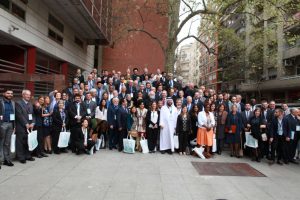
Griffith University’s Centre for Interfaith & Cultural Dialogue was among the key collaborators at the 2018 G20 Interfaith Forum, which closed in Buenos Aires on Friday (Sept 28).
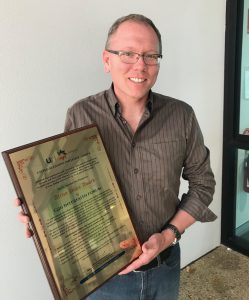
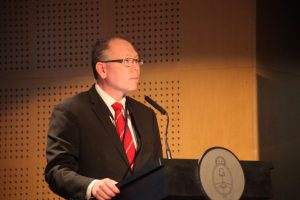
Dr Brian Adams speaks at the G20 Interfaith Forum.
Centre Director Dr Brian Adams (pictured) was in the Argentinean capital for the fifth annual staging of the forum.
“It is an honour to have spoken for the Forum organisers,” Dr Adams said.
“They are a group who have worked with immense dedication and commitment to bring this important gathering to pass. It is a ambitious offering to each of us, filled with hope and a vision of a better world.”
Religious and ethical issues tied to economy, development, and society have been discussed in detail across three days by political leaders, academics, lawyers, and civil society leaders.
Talks were guided by an overarching forum theme of ‘Building Consensus for Fair and Sustainable Development: Religious Contributions for a Dignified Future.’
“When we first developed the concept of the G20 Interfaith Forum more than five years ago, we saw an opportunity to showcase to the world that powerful contributions can be made when people and organisations from across religious, political, cultural and national boundaries work together to address pressing global challenges,” Dr Adams said.
“In particular, we wanted to demonstrate the extent to which religious and philosophical perspectives and initiatives can support the G20 agenda and contribute to the achievement of the UN Sustainable Development Goals. We do this while sharing experiences of best practice and research, and building relationships and networks across faiths and social sectors.”
In advance of the upcoming G20 Leaders’ Summit in Buenos Aires (Nov 30 — Dec 1), the participants looked at the part religious communities can play in promoting the goals of successive G20 Economic Summits.
The G20 Interfaith Forum helps identify and showcase the policy and societal contributions of faith traditions and philosophies on leading global issues.
Dr Brian Adams with the Africa Peace Award presented to the G20 Interfaith Forum.
Griffith’s Centre for Interfaith & Cultural Dialogue works to foster respect for one another through increased understanding of the religious, cultural and philosophical perspectives, of others.
Bolstering the Forum’s significance, the event was this year presented with the Africa Peace Award on behalf of the United Religions Initiative – Africa.
The award— which recognises the event’s “substantial contribution” to the G20 Economic Forum — was given in acknowledgment and appreciation of the Forum’s “outstanding work in bringing together opinion leaders such as scholars, lawyers and political leaders with faith and interfaith leaders from around the world”.
The Africa Peace Award also paid tribute to Dr Adams and the Forum’s organising team, noting the “tireless effort” that has gone into staging the event over the past five years “to facilitate peace and harmony between people of all religious and philosophical traditions while exploring ways to work together to strengthen human development”.





 “When we first developed the concept of the G20 Interfaith Forum more than five years ago, we saw an opportunity to showcase to the world that powerful contributions can be made when people and organisations from across religious, political, cultural and national boundaries work together to address pressing global challenges,” Dr Adams said.