The average Australian has approximately $113,000 invested in managed funds out of which $84,000 is invested in superannuation. The bulk of this is invested in the stock market.
As such Australians are most sensitive to the volatility in the stock markets. When the global markets tumbled this week, it sent a shock wave through the Australian market.
Everybody is scared and talking about the decline in global markets especially China.
The sharp decline in the market is of concern but we shouldn’t be alarmed. It is a correction in asset prices and investors should stay calm and focus on their longer term investment objectives rather than current shock.
China currently is the second largest economy in the world and has been growing at a fast pace over the past three decades. This growth in China was initially led by China’s exports to the world owing to low labour costs.
With the Global Financial Crisis there was a collapse in the global economic environment and demand for Chinese manufacturing declined. The Chinese government increased its spending on infrastructure development to keep pace with economic growth in China.
This infrastructure spending may have been important and required for future development of China. However, some of this infrastructure development was meant for continuing the economic growth (or GDP growth as is commonly measured). This was done in the belief that soon the GFC will be over and things will get back to normal.
Unreasonable
However, the GFC was protracted and severe resulting in a long period of infrastructure spending some of which was in unproductive assets. This implicit assumption of continuing infrastructure spending was an unreasonable assumption and was to be proven false. Once China pulled back on the infrastructure spending a normal growth rate which is more modest is causing panic around the world.
Unprecedented growth rate in China is appealing to all around the world. However, this higher growth is also important for the Chinese policy makers. Higher growth rate in China has allowed people in China to ignore any weaknesses and frustration; such as high level of corruption, high unemployment rate among educated youth (unemployment among recent university graduates ranges between 15% and 30%), increasing inequality in society and changes in social values.
In light of unprecedented growth all these weaknesses were ignored as everyone was enjoying the benefits of economic growth. And that may have been the reason for policy makers to try and maintain exceptionally high growth rates at any cost. I had been concerned about the belief that China will continue to grow at this rate even in 2009.
Recently President Xi’s government has been propping up the stock market and the Chinese public and the world believed that China was able to support the market for an indefinite period of time. However, despite all the support provided China’s stock market has declined and continue to decline.
We need to understand that regulators and government in China cannot continue to support Chinese market indefinitely. This correction was inevitable after a long period of rise in asset prices. Currently Shanghai A share index is still above 2014 levels and not significantly below the lowest point of 2015.
We also need to remember that China’s stock market is dominated by individual investors and generally considered as a speculative market. As such price movements may be more influenced by sentiments rather than fundamentals.
Finally, everybody is concerned about the decline across the world. However, this decline — though significant – is a single-day decline. Looking at longer term trends all markets (excluding China which rose exceptionally during 2015) have had a positive trend except for the past week and a half. Despite the significant drop, price levels are generally above 2009 levels in USA, UK, Australia and Germany.
An important issue policy makers in Australia need to consider is its reliance on China in terms of trade. Australia’s bilateral trade with China is more than 28% and continues to rise whereas with other major trading partners such as USA and Japan it is 6.7% and 13% respectively, and is declining as reported by Paramati, Gupta and Roca in a recently published paper in Applied Economics.
Australia’s bilateral trade with another rising economy such as India is at 2% and has declined over recent past. China’s GDP in 2014 was $10360 billion USD against India’s GDP of $2066. Australian bilateral trade with China is almost 14 times that of India, whereas China’s GDP is five times that of India.
Australia needs to decouple its economy from China and diversify its economic linkages with other economies and diversify its economic exposure to other global economic risk factors rather than being exposed to only China.
Dr Rakesh Gupta researches share markets and investments at Griffith Business School.
Science researchers at Griffith University have made their mark at the 2015WomeninTechnology (WiT)Awards night at the Royal International Convention Centre.
Gillian Fisher, a PhD candidate at the Eskitis Institute for Drug Discovery, was highly commended in the PhD Career Start category, while Dr Leigh Ellen Potter from the School of ICT received a commendation in the Life Sciences Research category.
The prestigious awards ceremony, now in its 18th year, recognises exceptional role models for youngwomenconsidering a career intechnologyor life sciences.
“The professionalism, intelligence and ambition of these women is just extraordinary,” WiT president, Fiona Hayes, said.
“They are leading the way in technology and life sciences from pioneering lifesaving medical research to developing vaccines and medicines, and from driving global conservation to running successful and innovative businesses.”
Gillian Fisher started studying science at the age of 40 and is now a nationally-recognised researcher in her field.
Her work is focused on the fight against malaria, which involves investigating new chemical classes of drugs to combat malaria parasite resistance.
She was also a 2015 finalist in the prestigious ASMR Queensland Health and Medical Research Awards.
Gillian was awarded a Griffith University Equity Scholarship and enrolled in a Bachelor of Forensic Science. She received the Griffith Award for Academic Excellence in 2005, 2007 and 2008.
Leigh Ellen Potter (left) was nominated for the Life Sciences Research Award, recognising significant contributions by women to the field of Life Sciences research and development.
She is the team lead for the ground-breaking Seek-and-Sign project, established to developtechnologiesto enhance the communication environments of very young deaf and hard-of-hearing children.
Leigh is also team lead for the Emerging Experiences Lab, a new research project working with emergingtechnology.
“The WiT awards are about celebratingwomenwho are experts in their fields and succeeding in male-dominatedtechnologyand life science positions,” Fiona Hayes said.
Two other Griffith researchers were nominated for the 2015 awards which covered nine categories.
Dr Qin Li from the Queensland Micro-and Nontechnology Centre, was also nominated in the Infotech Research category for womenmaking a recognised contribution to the field of ICT research and development.
Professor Michele Burford, Australian Rivers Institute, was among four finalists in the competitive Life Sciences Research Award category.
From minimum-wage worker to high achieving Griffith University Bachelor of Human Services student, Pip Giles is proof that anyone can change their life through study.
After finishing school at Year 10, Pip worked in a series of menial roles until, at the age of 35, she decided to follow her dream of working in community services and enrolled at TAFE.
“I’m particularly interested in helping young people and homeless youth,’’ she said.
“But when I looked into study, I thought a diploma would be too difficult so I enrolled in a certificate course instead.”
To her astonishment, she easily ploughed through the certificate and soon enrolled in a Diploma of Community Services which she also completed.
Emboldened by her success and encouraged by her TAFE teachers, Pip plucked up the courage to enrol in a Bachelor of Human Services at Logan campus.
Again, her fear of failure nearly held her back.
“After attending orientation at Logan campus, I was daunted by the magnitude of studying at university level and went back to TAFE. Then I thought I had to give it a go, so returned to uni.”
In the first few weeks she didn’t cope well with the study load and was nervous about submitting her first piece of assessment.
“I nearly quit and without the reassurance of a student support advisor who said my work was fine, I wouldn’t have had the courage to continue,’’ she said.
With initial fears quelled, Pip has gone from strength to strength with an outstanding GPA of 6.7.
“I’m still flabbergasted but I’m proof that if you study something you love, you can’t go wrong.”
Now her dream is to establish a youth refuge in Logan and her volunteer work with Rosies, Friends on the Street, has given her extra impetus to achieve that goal when she graduates.
Pro Vice Chancellor, Logan campus, Professor Lesley Chenoweth said the focus on adult learners at the campus was fundamental.
“Being acommunity oriented campus, Logan sees adult learning as a key strategy to build whole communities.AdultLearnersWeek (September 2-8) is realcelebrationof that commitment,’’ she said.
“We have invested in programs specifically about building aspiration and wideningparticipationfor adultlearners.
“So many of our students have re-engaged with education later in life, be that in their 20s and 30s after periods ofunemploymentorraisinga family. Some havecome from semi-skilled, trade type backgrounds and want to retrain. People seek out learning opportunities for all kinds of reasons.”
Pip will be on hand to talk to prospective students at the launch of Adult Learner’s Week at Logan campus Wednesday, September 2.
The program includes an Adult Learner Expo and inspirational stories from other adult learners. Guest speakers include: John Danalis, author of Riding the Black Cockatoo and Dr Jim Chalmers, Federal Member for Rankin, who will present REACH awards to adult learners.
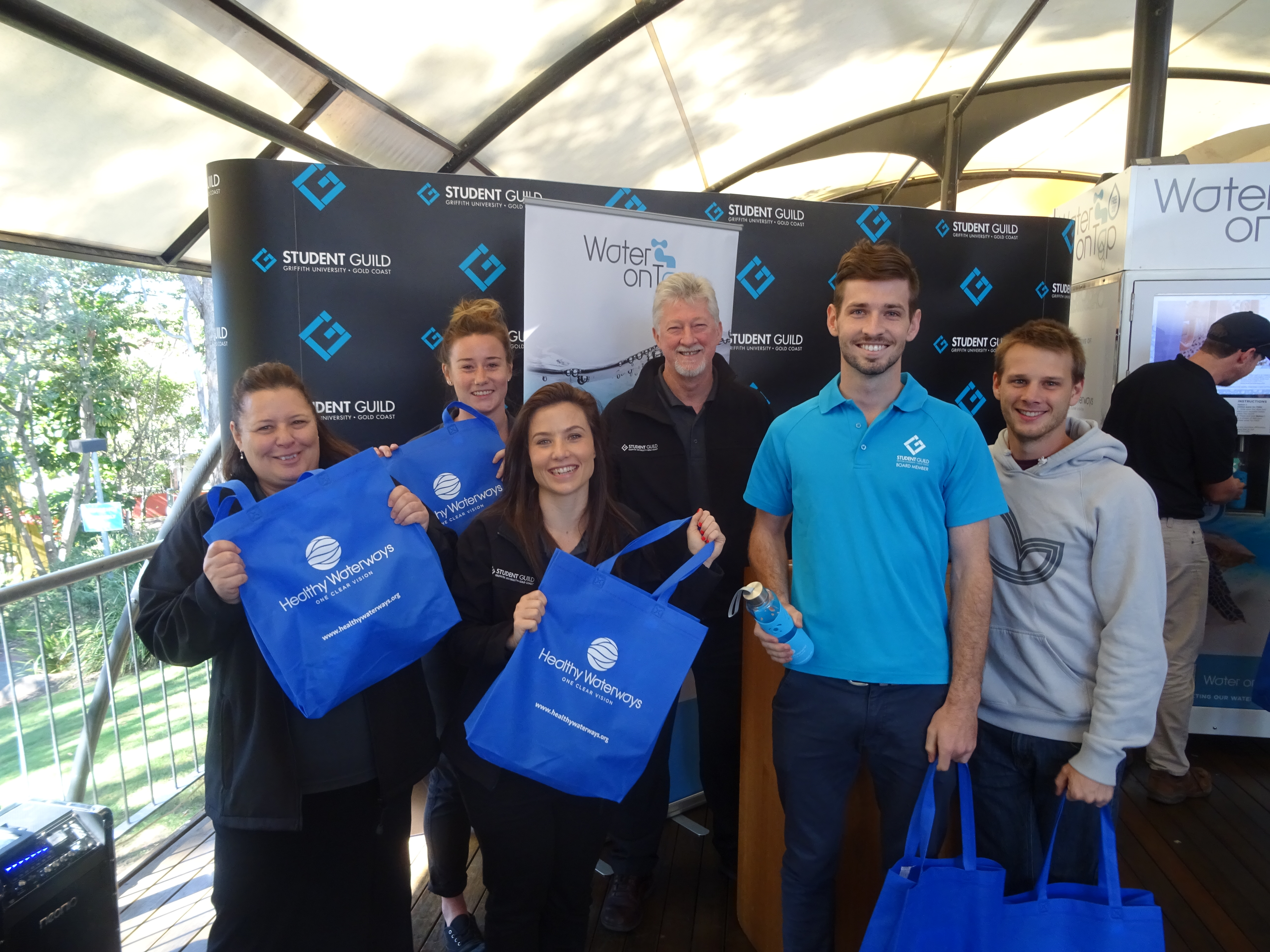
Australia’s first vending machine to dispense reusable bottles has students at the Gold Coast campus lining up for free chilled water.
The social venture called Water on Tap is an innovative social venture introduced by the Gold Coast Student Guild who partnered with not-for-profit organization Healthy Waterways to be one of only three locations across the country to trial it.
It has been running on campus in the lead up to Griffith’s Sustainability Week (August 31 — September 4) celebrations.
Healthy Waterways and Gold Coast Student Guild celebrate the launch of Water on Tap.
Student Guild President, Cameron Harrison, said plastic bottles constitute more than 22 per cent of waterway litter.
“The machine, which provides the option to bring your own bottle or invest in an exclusively designed reusable bottle, has been actively supported by the students,” he said.
And if you haven’t cycled in a while, now is the time to get back on your bike.
Griffith is encouraging students at Nathan campus to complete a Back on your Bike course for free. The course provides a refresher of the basics such as handling, setting up your bike, safety checks, starting, stopping, braking, using gears effectively, turning and balancing.
Committing to reusing plastic bottles or cycling instead of driving is just two ways students, staff and the community at Griffith can reduce the impact on the environment.
Griffith is encouraging everyone to sign up its Sustainability Commitment and take the pledge to make small changes every day.The first 500 staff and students to sign this pledge will receive a free reusable cup and coffee.
Deputy Vice Chancellor (Engagement) Professor Martin Betts said Griffith was a university of influence that is committed to a robust, equitable and environmentally sustainable society.
“The principal of sustainability has been a core commitment since its foundation over 40 years ago.
“Achieving sustainability against the prospect of long term social and economic dislocation, as the result of environmental derogation, is increasingly the focus of international efforts by governments, business, researchers and educators, community groups and individuals.”
Other recent sustainable initiatives enabled by Griffith include:
Community Garden — students living on the Gold Coast campus and Mt Gravatt campus grow their own fruit and vegetables
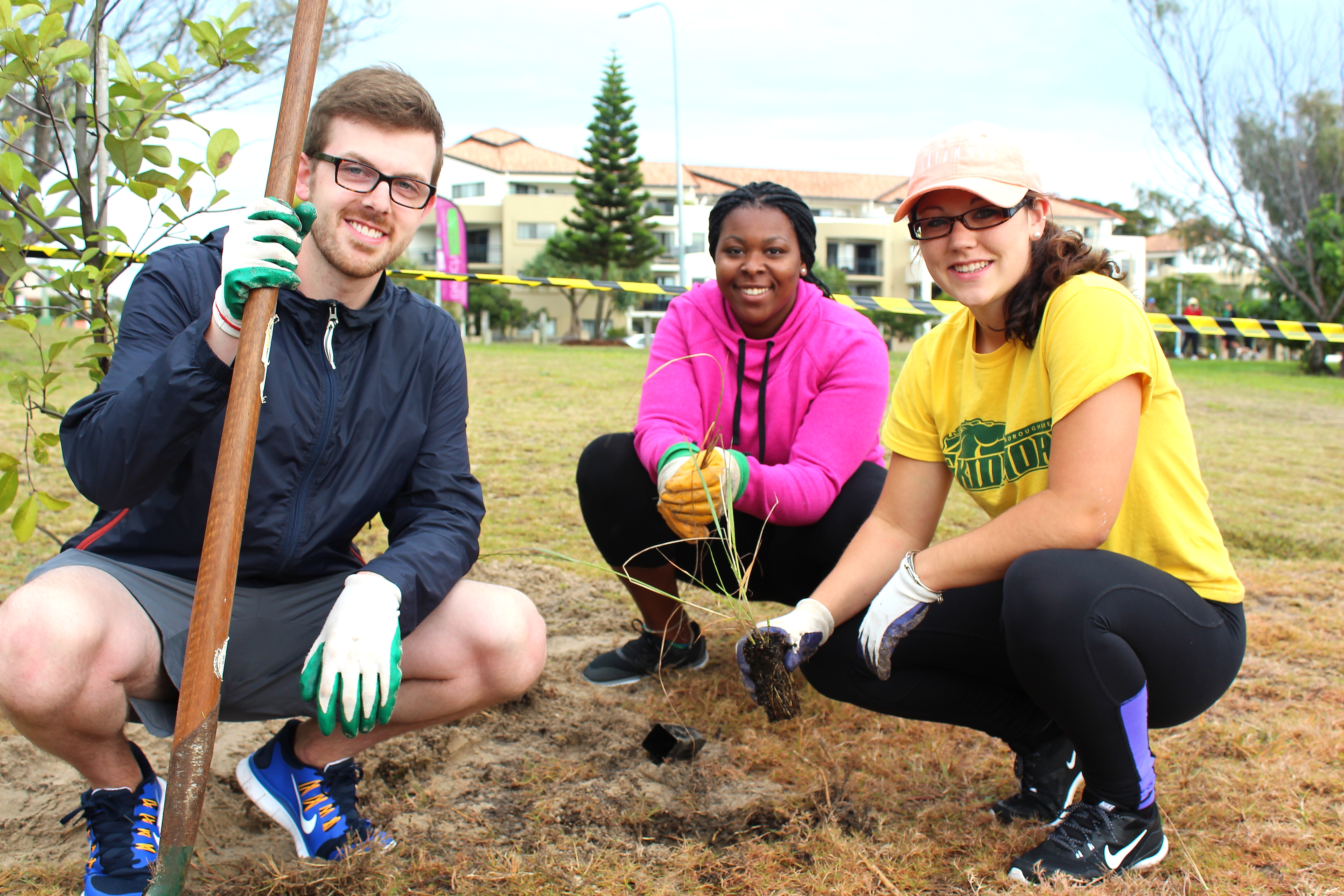
Participants on Griffith’s BeachCare Program
BeachCare program — Community based program facilitated by the Griffith Centre for Coastal Management which plants trees, collects weeds and litter along Gold Coast beaches.
End of trip facilities for cyclists around Nathan campus
Free intercampus buses between Gold Coast, Nathan, Logan and Mt Gravatt.
Rare and threatened plant walk along University Drive on the Gold Coast
Recycle your mobile phones and batteries on all campuses
New car park at Gold Coast which features a highly visible wind turbine, solar panels and includes green walls and bat and bee boxes.
Special activities will be held across all campuses during Sustainability Week. See the full Sustainability Week program here.
‘Bold’, ‘ambitious’, ‘unprecedented’ and ‘visionary’.
Or in the words of United Nations Secretary-General Ban Ki Moon: “universal….transformative….integrated” and “an historic turning point for our world”.
If the rhetoric and the Secretary-General are to be believed, the 2030 Agenda for Sustainable Development and its Sustainable Development Goals (SDGs) will ensure that across the world in 15 years:
“poverty will be eradicated, prosperity shared and the core drivers of climate change tackled.”
Can the 2030 agenda live up to the hype and its own ambitions? What could the SDGs mean for the development of international sustainable development law? Could the imperfect international law and SDG frameworks complement each other to set humanity on a path towards sustainability?
The 2030 Agenda for Sustainable Development
The finalised text for adoption of the 2030 agenda was released on August 2, 2015. It is unlikely that the text will differ significantly, if at all, when adopted at a high-level plenary meeting of the 69th UN General Assembly in September 2015.
Despite claims of integration, there is unnecessary disconnect between and within the goals. Marine (Goal 14) and terrestrial (Goal 15) issues are addressed in separate goals while the management of water resources is awkwardly combined with sanitation (Goal 6). Worryingly, the SDGs fail to recognise the trade-offs that will be required between goals.
Griffith Law School’sDr Rak Kim has emphasised that the creation of a “mutually supportive relationship between the SDGs and international law will be critical for effective implementation of the post-2015 development agenda.” Despite this, only three conventions are explicitly included in the SDGs.
There is ringing endorsement of the UN Framework Convention on Climate Change (Goal 13) and the UN Convention on the Law of the Sea (Target 14.c). Though the Framework Convention on Tobacco Control was deemed worthy of inclusion (Target 3.a) neither the UN Charter nor human rights conventions have made it into the SDGs. Reference is made to “World Trade Organisation agreements” (Target 10.a) but only in terms of special and differential treatment for developing countries. Further, none of the 31 targets of the ‘justice’ and ‘implementation’ goals (Goals 16 & 17) make any reference to international law.
Outside the SDGs, the agenda’s declaration includes a scattered collection of international instruments. This includes the UN Charter, the Convention of the Rights of the Child, the Universal Declaration of Human Rights, and ‘other international instruments relating to human rights’.
Neither the International Covenant on Civil and Political Rights nor the International Covenant on Cultural, Social and Economic Rights are referred to explicitly in any part of the agenda.
Despite recognition in the agenda’s declaration of the ‘positive contribution of migrants’ to ‘inclusive growth and sustainable development’ and ‘the humane treatment of refugees and of displaced persons’, neither the 1951 Refugee Convention nor the principle of non-refoulement or indeed international law are mentioned in relation to migrants or refugees.
None of the biodiversity-related Multilateral Environmental Agreements are included in the SDGs. The only reference to the Convention on Biological Diversity (CBD) is commitment-phobic language in the declaration which merely states that “we look forward to” the next Conference of the Parties of the CBD. Glib attestations in the declaration such as ‘full respect for’ and ‘commitment to’ international law gloss over the fragmented and conflicting reality of the international law framework.
Sustainable Development and International law
Despite significant academic discourse and jurisprudence surrounding sustainable development and its potential customary international law status, it remains unclear whether ‘sustainable development’ is a binding principle of international law or merely an objective or a concept. At the same time, implementing sustainable development and reconciling and coordinating legal regimes across social, economic and environmental spheres presents significant challenges.
Sustainable development law concepts, however, do hold much potential for guiding implementation of the SDGs. Intergenerational equity for example, provides essential direction in relation to temporal considerations. This concept underlines the importance of implementation of the SDGs which looks far beyond the 15-year horizon of the 2030 agenda.
What next?
Neither the SDGs nor sustainable development law are sufficient for ensuring human and planetary well-being in the short or long term. Considered together there is the possibility that each framework may address gaps in its counterpart, but greater coordination between the two is needed.
International law needs to bridge human rights, economic and environmental law divides. Greater ties also need to be established between international law, international decision-making and other disciplines.
The enormity of the challenge of reconciling interacting legal regimes means that there is also the need to look beyond the traditional tools of the international lawyer to systems-based approaches such as conceptual modelling and network analysis.
Reinforcing the core values that drive Griffith’s MBA program is a natural step for new Director, Associate Professor Chris Fleming, who sees the Griffith MBA as very much a program for its time.
Associate Professor Fleming believes the values on which Griffith Business School was founded have stood strong in the wake of 2008’s Global Financial Crisis and are as relevant today as any time previously.
“Around the world there was widespread dissatisfaction, often led by students, with how business schools were run after the GFC,” he says. “A genuine demand for a shift in the focus of business schools emerged, where a responsible, holistic approach to business and business thinking was now a priority.
“This was signalled strongest through the ‘Occupy Wall St’ movement. Gordon Gecko’s ‘greed is good’ mantra was consigned to the trash heap. Business schools couldn’t ignore it anymore.”
The Griffith MBA was well positioned to embrace this social spirit, with its established structure around three core values of responsible leadership, sustainable business practice and a global orientation with an Asia Pacific focus.
“We infuse our business leaders with these values, which are integrated through all of the MBA courses from sustainability to economics,” Chris Fleming says. “Our MBA is driven by these values and the values of the academic staff teaching into it. These values are up front and central to every discussion with every student.”
The values have remained constant as the structure of the MBA program has been revisited on the back of the digital revolution. In November last year, Griffith University took online education to a new level to meet the fast-changing needs of a modern, global student community.
A sophisticated new online MBA program opened the door for students to start their studies when and where they wanted.
“Digital education is both the biggest opportunity and the biggest challenge going forward,” Chris Fleming, an applied micro-economist, says.
“As our program evolves in step with the demands of digital education during the decade ahead, I expect the MBA experience for Griffith students to continue to improve, keeping the Griffith MBA ahead of the pack.”
High ranking
The Griffith MBA has stood out from the crowd on a range of fronts during the past two years. It is the highest-ranking Australian MBA in the Aspen Institute’s Centre of Business Education’s most recent Beyond Grey Pinstripes Global 100 list, ranking at 26 due to its focus on responsible leadership, sustainability business practices and the Asia-Pacific region.
It was also ranked in Australia’s top 10 by the Australian Financial Review BOSS Magazine MBA survey; it featured in CEO Magazine’s top 20 Global MBA Rankings for 2015; and was shortlisted for the inaugural Wharton-QS Stars Reimagine Education Awards last year.
After taking out a Green Gown Award in 2013, the program’s credentials were consolidated when – in a first for an Australian MBA program — it offset the effect of its greenhouse gas emissions.
“Business leaders have a responsibility to not only look after the balance sheet and their shareholders, but also to look after the planet and the community where they live and operate,” Associate Professor Fleming says.
“Because of its heritage, Griffith University is ideally placed to continue to deliver the best MBA in the country. And with our new online model, there is no reason why someone in Asia, Europe or Africa cannot do an MBA at Griffith”.
Associate Professor Chris Fleming has been appointed the new Director of the Griffith MBA, bringing to the role a wealth of economic knowledge and experience from the private and public sectors.
Chris Fleming’s body of academic research ranges from environmental economics to tourism economics and from climate change economics to the economics of happiness. Life satisfaction in a social and economic context is a key focus, as is societal welfare, and will continue to inform the evolution of the Griffith MBA.
Prior to joining Griffith Business School, Chris Fleming worked as a senior advisor within the Sustainable Development Policy Group of the New Zealand Ministry for the Environment. He previously worked in the Ministry of Economic Development.
He moved to Australia from his native New Zealand in 2004 and completed a PhD at University of Queensland before working as a senior consultant with Marsden Jacob Associates. His move to academia, initially in Victoria, ultimately led to Griffith University where he was a founding member of the Asia-Pacific Centre for Sustainable Enterprise in 2009.
Along with a PhD (Economics) from University of Queensland, he also holds Bachelor of Arts (Economics) from the University of Otago and a Master of Applied Economics with first class honours from Massey University.
He was the co-author of a series of studies into how an effective and efficient Reef Trust be established to preserve the international tourism icon. The Reef Trust is now a key mechanism assisting in the delivery of the Commonwealth Government’s Reef 2050 Long-Term Sustainability Plan.
He is a senior associate of MainStream Economics and Policy.
The wave of new talent emerging from the Gold Coast will be celebrated in the latest SEED Volume 4 album, launching at Miami Marketta on Wednesday 2 September.
Featuring the cream of the crop from Queensland Conservatorium’s Bachelor of Popular Music program, the night will showcase ambient rock artist Aquila Young, indie folk band Fox and Fiasco, electronic diva Phoebe and blues folk master Fletch.
The event will also feature the exclusive premiere of SEED Stories, a series of artist documentaries presented through a partnership between More Gold Coast, the Queensland Conservatorium and some of South East Queensland’s best filmmakers; and a sneak peak of the Espial exhibit by the Queensland College of Art.
As always, this year’s SEED album is diverse, presenting a wide range of artists and genres including dirty jazz, psychedelic rock, indie folk and floating electronica.
Seed is an innovative initiative led by Queensland Conservatorium and Griffith Enterprise, to giveemerging contemporary artists a head start.
Each year the Bachelor of Popular Music students’ best songs are compiled into an album and distributed through major online stores.
Featured artists then receive genuine career building and learning experiences, industry connections and numerous high-profile performance opportunities including a ten-week concert series at QPAC and festivals such as the Bleach* Festival, Blues on Broadbeach, Broadbeach Country Music Festival and many more.
The BPM is the same program responsible for launching the careers of musicians such as The Kite String Tangle, The Delta Riggs, Bobby Alu and The John Steele Singers.
Exploring how future teachers can apply financial literacy education in their mathematics education classes is the focus of a new Griffith PhD thesis topic.
School of Education and Professional Studies PhD Candidate Levon Blue is using a case study to explore the financial literacy education practices in a First Nation community in Canada, of which she is a member.
Financial literacy education aims to develop skills in young people on how to manage money and make informed financial decisions.
Levon says she chose Griffith University because of the facilities available to her, and the important research her supervisors were conducting in and around her key area of interest.
“I’ve increased my research and teaching skills through workshops offered to HDR students at Griffith, and have taken on sessional tutoring opportunities and research assistant roles,” she says.
“I’ve also attended and presented at a number of domestic and international conferences, and currently have eight published articles as a result of the opportunities here at Griffith.”
Prior to commencing her PhD, Levon worked for both the Canadian and Australian governments in senior finance roles, consulting on projects and training managers, Principals and School Executive Officers about school budgets.
“It was during my Masters degree in Training and Development, specialising in professional development, that I began to focus on financial literacy education,” she says.
“I realised that more research was needed to properly guide the process of financial literacy training in higher education for pre-service teachers, and to help direct government policy.”
Following the submission of her PhD thesis in early 2016, Levon intends to continue working in academia in a dual teaching and research capacity.
Levon is supervised by Associate Professor Peter Grootenboer from the School of Education and Professional Studies and Associate Professor Mark Brimble from the Griffith Business School.
Elly Hoyt will soon touch down in her father’s homeland of USA, to undertake a prestigious Masters in jazz performance.
As only one of four jazz vocalists selected worldwide, Elly will attend the New England Conservatory (NEC) in Boston for the next two years to learn from some of the world’s leading jazz musicians.
The 28-year-old Queensland Conservatorium Griffith University graduate says it will be an incredible time for her to consolidate what she does know, while exploring what she doesn’t.
“Being able to spend two whole years immersed in my craft is what I’m most looking forward to,” she says.
“The best decisions come when you know yourself and what works for you, so I hope that this time will become a new foundation for my future.
“This is perfect timing for me — right now Boston is where I need to be, it’s like a blueprint in my body.”
This timing is also reminiscent of her family in Tasmania where she grew up. Elly’s father, Stewart Hoyt, left America when he was 28 to come to Australia — so it’s a place close to her heart.
“I feel quite at home in America and to be able to return to my heritage is such a treat.”
“I’m excited about working with incredible musicians including Dominique Eade and Ran Blake who will be my teachers in my first semester at NEC”.
Elly also received a Martin Bequest Travelling Scholarship to assist with her journey to Boston, marking the first time a jazz musician has been awarded the honour in the 40 year history of the prize.
Wowing audiences with her soulful voice since she was just five years old, Elly paved her way into the Australian jazz scene when she won the prestigious Generation in Jazz vocal scholarship in 2008, which was judged by James Morrison.
“From the moment I first heard Elly sing, I knew she had that classic, indefinable thing that makes one a jazz singer,” Mr Morrisonsaid.
“It’s not just a sound, or a choice of notes but a way of approaching a song that lets the listener know – this is the real thing.”
Elly released her debut self-titled album in late 2010 and won Best Australian Jazz Vocal Album at the Australian Jazz Bell Awards the following year.
After completing her Bachelor of Music majoring in jazz voice, Elly went on to undertake her Masters of Vocal Pedagogy with Dr Irene Bartlett, while also teaching at Queensland Conservatorium.
Her latest album ‘Oranges & Sunshine’ was released March 2015 and is available on iTunes.