Last year’s Federal Budget produced an unwelcome surprise for the major banks in the form of the Banking Levy. The cries of pain from those affected are now long since forgotten and any remaining sympathy for their situation has dissipated given what has been uncovered by the Royal Commission into Misconduct in the Banking, Superannuation and Financial Services Industry. With the Commission revealing what is seemingly a systemic problem in the industry, attention has now turned to whether and how the banks and other major financial institutions might be penalised and further regulated.
Against this background, the 2018 budget becomes all the more interesting; not because it does anything to single out the banks and others in the financial services sector for special (punitive) treatment as a response to their wrongdoings highlighted by the Commission, but rather because the budget is likely based on economic modelling and forward estimates that assume the sector to be in robust financial health.
And that is a potential problem.
Already, extra jobs and a stronger-than-anticipated economic performance have bolstered tax receipts by nearly $5 billion more than estimated in the mid-year review last December, and the expectation is for the budget to return to the black sooner than previously forecast. At the same time, the government is predicting that a cut in the company tax rate will lead to greater economic output, increased employment and higher wages, and that with this growth will come increases in government revenue. Confidence in these predications is what has enabled the government to announce that it will no longer seek to increase the Medicare levy in order to support the NDIS, and has provided it with room to increase expenditure across portfolios whilst also delivering income tax cuts to low- and middle-income earners.
“…it is not unreasonable to assume that there will be some significant fallout in relation to the financial performance of the industry in the next few years.”
But with the banking and financial services sector in disarray — and further revelations about malpractice no doubt likely to emerge as the Royal Commission rolls on this year — it is not unreasonable to assume that there will be some significant fallout in relation to the financial performance of the industry in the next few years. Not least, a lack of public trust and confidence in financial products and services may see a downturn of sales and activity. Furthermore, it is likely that the Commission will hand down recommendations that lead to a more stringent regulatory environment that includes bigger financial penalties for misconduct and which will substantially increase compliance costs within the industry. All this could impinge on performance and profitability in banking and financial services for at least the short to medium term, and lead to (notably overseas) investor nervousness in the sector. One could even go further seeing a downturn in the sector’s performance impacting on the financial markets and the economy overall.
Such a scenario has implications for how we view the 2018 budget. The Government is aiming to return to a budget surplus of about 0.5 per cent of GDP. That for some — including Labor — is believed to be too slim and leaves the economy vulnerable to economic volatility. Notwithstanding the planned cut in the corporate tax rate — and there is an argument that this may be of vital assistance to banking and financial services given what else may be coming down the line for it — the budget is, at least in part, based on a revenue base that assumes continuation of the recent strong performance of the sector. These calculations may not though take into account any possible downturn in economic activity in the sector and the impact of this on government revenue.
In short, if the budget is based on economic modelling and forward estimates that assume things will continue as they are in the banking and financial services sector and not as they could turn out to be, that could be bad news for the government’s delivering on what they have promised and its capacity to secure budget repair.
So while we may all agree that the Royal Commission will achieve a great deal and was long overdue, there may, in the context of the 2018 budget, be a significant price to pay for what it has revealed.
The context of this federal budget is characterised by a favourable alignment of political and economic incentives. Given 2018 is an election year, the political incentive for the government is to strengthen its consensus by adopting “expansionary” budget measures such as lowering taxes and increasing expenditure (possibly targeted to key constituencies). At the same time, with the Australian economy still running below potential, these same expansionary measures will help stimulate aggregate demand and close the gap between actual and full-employment potential Gross Domestic Product.
This alignment of incentives means that the government does not have to choose between what is good for the economy and what is politically convenient. The only possible downside risk is that by engaging in expansionary measures, the government could compromise its fiscal consolidation strategy and hence disrupt the path towards a fiscal surplus. However, the estimates available from the Mid-Year Economic and Fiscal Outlook 2017-18 and the IMF Article IV Consultation released earlier in 2018 project a steady increase in fiscal revenues, which in turn creates the fiscal space for expansionary measures.
In other words, when he took the stage, Treasurer Scott Morrison was in a truly advantageous position: he had the fiscal space to deploy the expansionary measures required to support the economy and increase consensus for its government in an electoral year. The only thing he had to do was to deliver these measures convincingly.
Did he? My answer would be: to some extent, but not in full.
“…this budget missed the opportunity to promote more drastic interventions to support employment.”
The budget does include some “textbook” expansionary measures, above all the cut in the personal income tax rate for low and middle incomes coupled with a generous allocation to expenditure in infrastructure. Lower personal income taxes are expected to stimulate private consumption, even if it is to be seen how significant the impact of the measures proposed in the budget will be. Spending on infrastructure is always popular among Treasurers, and this time it looks like a sizeable share is coming to Queensland.
In addition, the proposed investments in age care, mental health care, and medical research are welcome examples of how the government is trying to strengthen the supply of some public goods that are needed for long-term inclusive growth. On the other hand, given the favourable context, this budget could have done more to support education, particularly after the interventions introduced in December 2017.
On the negative side, this budget missed the opportunity to promote more drastic interventions to support employment, such as active labour market policies that encourage requalification and mobility of workers across sectors and regions. These policies would have also been useful in a longer-term perspective to support the process of structural transformation of the Australian economy.
Similarly, the budget contains only limited provisions to promote regional development, which is a concern given that inequality in Australia has a strong geographical dimension. Finally, the continued commitment of the government to the corporate tax cut is not good news, as this measure is unlikely to stimulate the real economy while it does contribute to sharpening inequalities.
1999 was a great year to be alive in Australia. Apart from Prince hitting the airwaves again, Powderfinger were still playing and topped the Hottest 100, the first Matrix movie was released, and you could still get a flat white for under three dollars. In terms of the Federal Budget, 1999 marked the start of a remarkable period in which the Federal Budget accumulated approximately $90 billion dollars between 1999-2008.
2018 is starting to look a lot like 1999, at least in terms of international commodity prices. While global growth remains sluggish and domestic business investment is stuck in a low gear, the underlying cash balance of the Federal Government is projected to reach surplus in the coming quarters thanks to the strong performance in commodity prices, such as an iron ore.
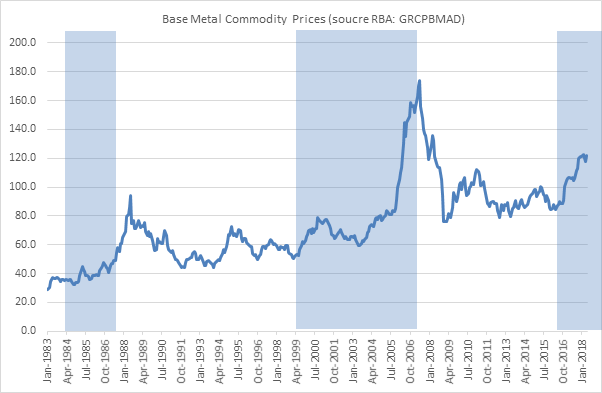
Rising iron ore prices drive up earnings in the resource sector and therefore tax revenues. The chart below highlights the link between commodity prices and the Federal Budget. The shaded areas highlight phases in which there were significant returns to surplus in 1985-1987, 1999-2007 and 2016 to present.
These phases of fiscal recovery coincided with a significant upward jump in the commodity prices. The only period where the fiscal position improved in the absence of rising commodity prices was immediately after the 1992 recession.
While a recovering fiscal position is warmly welcomed by politicians, especially with a federal election just around the corner, it is worth reflecting on the fact that many of these new spending opportunities are caused not by sound economic management, but are rather due to global market forces that are extremely volatile in nature and hard to predict.
It is much too tempting for governments to view these upward movements as permanent. Any new spending initiatives are thus likely to be built on shaky foundations. New spending initiatives should be tagged with the big asterisks flagging “funding initiatives will only last as long as global commodity prices keep surging”.
A much deeper issue is how the Australian economy can evolve to grow in a more balanced manner and reduce its exposure to falling commodity prices. This fundamental question has bedevilled Australian politicians for centuries since the gold rushes in the 1800s. Having recently emerged from a commodity supercycle between 2004 and 2013 (see figure above), its funny how some of the lessons from the last commodity boom have already been forgotten. In 2013, there was much agreement that Australia had squandered the mining boom mainly due to having spent the windfalls during the boom, raising inflation and debt levels.
“…many of these new spending opportunities are caused not by sound economic management, but are rather due to global market forces.”
A more strategic approach would consist of getting a national response to rising commodity prices right by setting up Sovereign Wealth Funds that can translate short-term gains into long-term investments in health (NDIS), education and infrastructure that will help hedge Australia’s economy against future downturns in commodity prices. A good start was made in this direction as some of the mining boom surplus from the last super cycle was put towards the education investment funds.
However, we are still far behind other countries such as Norway, Singapore and the UAE in terms of developing a sophisticated long-term strategy to leverage future surges in commodity prices (and improvement in the Terms of Trade) to diversify the economy and support long run productivity growth. While the long run return to surplus is good news, it’s time we take heed of the lessons from the recent past.
While Jessica Mauboy is flying the flag for Australia at this year’s contest, formerYoung Conservatorium studentNicole Blair has penned the UK’s national entry.
Herpiano ballad, Storm, will be performed by English singer SuRie at Sunday’s Eurovision finals.
The contest reaches an estimated 200 million television viewers worldwide, and Nicole is heading over to Lisbon, Portugal for the finals.
She admits her loyalties may be divided if Australia makes it into the finals.
“To keep things fair, you can’t vote for your own country, so because I’m UK-based, I won’t be able to vote for SuRie!
“I do love Jessica Mauboy’s song, so maybe Australia will get my vote.
“But at the end of the day, I see Eurovision as a competition to celebrate songwriting. Everyone is so encouraging of each other, whether they are writing for their own country or another country.
“It’s such a brilliant competition – daunting but brilliant.”
Nicole started studying at the Young Conservatorium when she was 11 years old and was mentored by senior vocal lecturer Dr Irene Bartlett, who has shaped the careers of artists like Dami Im, Katie Noonan and Megan Washington.
“Irene is actually one of the main reasons that I am doing what I am doing today,” she said.
“Irene went above the call of duty, helping me in so many ways to further my talent and believe in myself. I will forever be grateful for her support.”
As well as being a keen singer, Nicole first started penning her own compositions as a teen.
“I wouldn’t want anyone to hear those ones – they are locked and sealed away! I’ve probably have written over a thousand songs since then.”
After completing her studies at the Young Conservatorium, Nicole moved to Stockholm and then London to pursue her songwriting career.
“I find that Europe is the place where I am most successful, it has got something I can’t describe.
“Stockholm is a beautiful inspiring city and London has an incredible creative scene.”
So what does the future hold for Nicole?
“Every song that gets a home is one more step closer to my goal and I have to keep writing and getting better and stronger,” she said.
“I have my own releases coming this year, and I’ve been working with incredibly talented artists such as Imani Williams and Pixie Lott.
“I want to travel the world and work with as many different people as possible – that’s the dream.”
Dr Irene Bartlett said Nicole was a rising talent in the international music scene.
“She is a very good singer herself, and the fact that she can also write for other people will give her longevity and a very lucrative career.
“I’m delighted to see her success – she is a lovely kid with a lot of drive and determination.”
Queensland Conservatorium Director Professor Scott Harrison said the Young Conservatorium program was a successful training ground for aspiring musicians.
“The Young Con offers a pathway for pre-school, primary and secondary students that draws on the skills, expertise and excellence of the Queensland Conservatorium.
“It is fantastic to see former students like Nicole enjoying success on the world stage.”
The Eurovision Song Contest finals will be broadcast on SBS at 7:30pm, Sunday 13 May.
Alumni and faculty from Griffith Film School have received funding to pursue their dream projects as part of a Screen Queensland short film competition.
Screen Queensland’s SQ Shorts Program has funded the production of 12 short films to allow emerging filmmakers to develop standout stories for the screen.
SQ Shorts is supporting a range of films that includethree ‘edgy’ genre shorts; three Aboriginal and Torres Strait Islander films; three short horror films and three comedy pilots.
Nine GFS graduates have had their work selected — beating out hundreds of entries from around the state.
As part of the Screen Queensland program, the filmmakers will develop and produce 8-10 minute genre films, each with a budget of up to $40,000.
The completed films will premiere at anumber of popular international film festivals and events around the world, including Screamfest, the largest and longest running horror film festival in the United States.
Griffith grads sweep competition
Head of Griffith Film School Professor Herman Van Eyken said it was gratifying to see GFS graduates sweep the pool of entries.
“It is a huge honour for our graduates to win entry into this program,” he said.
“This initiative will give emerging filmmakers the money to develop their dream projects, and the opportunity to present their work to an influential audience overseas.
“The fact that many of the winning teams featured GFS graduates and faculty speaks volumes about the calibre of our programs.
“It is also evidence of the strong connections between Griffith Film School, organisations like Screen Queensland and the international film industry.”
A life changing opportunity
Griffith Film School graduate Josh Long was selected for last year’s program, and had his short horror film, Post Mortem Mary, screened at Screamfest in LA. He will mentor this year’s SQ Shorts winners.
“Being part of this competition has changed my life andhelped open doors in the industry for me,” he said.
“Through the support of Screen Queensland I was able to make a great Australian gothic horror film andwork with filmmakers far more talented then myself, including many Griffith Film School alumni.
“I’ve been accepted to the Asia Pacific Screen Lab. I’ve recently been a director attachment on the feature film Escape and Evasion, and I’m currently mentoring one of the next wave of SQ Shorts winners.
“The next step is a feature film!”
Supporting young filmmakers
Griffith Film School graduate Henry Boffin will write and direct a short sci-fi film called Lavender, with a host of fellow GFS crew including Robert Bakken (Director of Photography), Shannon Male (Production Design) and Ahmad Halimi (Editor).
Henry graduated with a Bachelor of Film and Screen Media Production (Honours) in 2013. He said winning a spot on the SQ Shorts program would enable him to pursue his passion for filmmaking.
“As a filmmaker, you have to have to have a burning passion, great ideas and a knack for telling stories,” he said.
“But making films is very expensive and time consuming, so in the past, I’ve had to crowdfund projects or ask the cast and crew to volunteer.
“Having the funding to go ahead and make this film is fantastic – it’s very validating.”
Other Griffith Film School alumni selected for the 2018 SQ Shorts program include:
Mary Duong (Producer) – For A Good Cause
Danielle Redford (Producer) – And The Winner Is
Cameron March (Director) – And The Winner Is
Jordan Lynagh (Writer) – And The Winner Is
Brenton Pinsent (Producer) – Stray
Katherine Chediak Putnam (Writer) – Stray
Dean Law (Director/Writer) – Stray
Helen Morrison (Producer) – My Name is Mudju
Fresh off the back of a triumphant performance at the Commonwealth Games closing ceremony, the multi-platinum artist is now in the middle of a national tour.
“I see this album as a bridge from my past to my future,” she said.
“I wanted to explore the kind of music I used to do before the TheX Factor and Eurovision.
“I feel like its time to show more of myself as an artist.
“In fact, I first learnt to sing many of these songs while I was studying at the Con.
“For me, this is where my whole journey as a singer began.”
The Masters of Music Studies graduate shot to stardom after winning The X Factor in 2013 and represented Australia in the 2016 Eurovision Song Contest.
Dami said the global exposure that came with her dazzling Eurovision performance made her re-evaluate her career.
“After Eurovision I had a big opportunity to showcase my music across the world, and it really forced me to think what I wanted to do in 10 years, and come up with a long term plan,” she said.
“I felt a real pull to reconnect with my roots, and connect all my experiences – and that meant returning to jazz.”
Dami’s current tour reflects her change of direction – the massive arenas have been replaced by a series of intimate gigs around the country.
“This tour is different for me – I’m purposefully keeping things small and playing in tiny venues,” she said.
“I want it to be a really intimate, boutique experience, and I’ll be playing with a small jazz quintet – it’s about really connecting with the people in the crowd.”
The powerhouse singer credits her time at the Queensland Conservatorium with shaping her into a seasoned performer.
“My time at the Con helped massively,” she said.
“A lot of people like to believe that X Factor was my first time on stage, but I’ve spent my whole life doing music – first at the Young Con, then doing my Masters in jazz vocals.
“While I was at the Con, I was lucky enough to be mentored by Irene Bartlett – she taught me everything I know about the biology of how the voice works and how to look after my instrument.
“Sheinspired me to be a grounded artist – to be yourself, while being a success.
“My experience on the X Factor isn’t for everyone – for me, it worked out well, because I found it hard to push myself forward and promote myself.
“But having proper training and great mentors and teachers is so important.
“It has helped me have more longevity as an artist.”
Dr Irene Bartlett remembers Dami discovering jazz at the Queensland Conservatorium.
“She came into the Masters program as an incredibly accomplished piano player who’d taught herself how to sing,” she said.
“She wanted to learn how to really belt, and her own material was quite pop / gospel.
“She was introduced to jazz here at the Con, so it’sheartwarming to see that she’s rediscovered her love of jazz repertoire.”
Queensland Conservatorium Director Professor Scott Harrison said the Con had produced many remarkable vocalists who had transformed the Australian music scene — from Dami to Katie Noonan and Megan Washington.
“Dami is one of many talented alumni making their mark on the world stage,” he said.
“We remain the dream destination for aspiring young musicians from around the world — this has been confirmed by our position among the top 50 performing arts programs in the world, and our recent ranking as the country’s leading creative arts school.”
The Griffith University Violence Research and Prevention Program in partnership with the Queensland Government will host a public forum to discuss the Queensland Domestic and Family Violence Death Review and Advisory Board’s foundation year findings on Tuesday, May 8.
The Honourable Yvette D’Ath MP, Attorney-General, Minister for Justice and Leader of the House will open the forum.
Chaired by the State Coroner, the Queensland Domestic and Family Violence Death Review Board examines domestic and family violence deaths in Queensland.Between 2006 to 2017, 263 women, men and children were killed by a family member or a current or former intimate partner.
The forum will examine key themes and and issues discovered by the Board throughout itsreviewof these deaths as well as recommendations to prevent further fatalities.
Professor Paul Mazerolle
“Domestic and family violence deaths have far-reaching impacts on families, first responders and other service providers, and the community more broadly,’’ says Professor Paul Mazerolle, Director, Violence Research and Prevention Program.
“By harnessing the collective capabilities of researchers, government agencies, and the community sector, we can strengthen our efforts to prevent domestic and family violence in Queensland.
“We support the Domestic and Family Violence Death Review and Advisory Board’s commitment to identifying system failures, gaps or issues and making recommendations to improve practices and procedures that aim to prevent future deaths.
“Through the Violence Research and Prevention Program’s ongoing research into intimate partner homicide, we will continue to contribute to this goal.”
The forum will be held at Griffith University’s South Bank campus from 4pm-6pm.
Mr Peter Ward, Managing Director, Wardy IT Solutions.
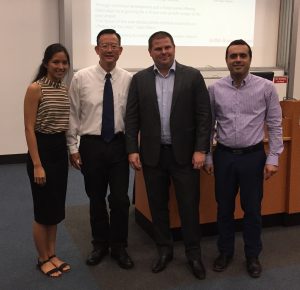
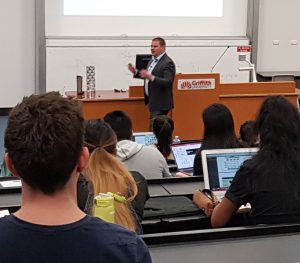
Linkage with the industry provides students with first hand insights of how the concepts taught in 1005IBA (Introduction to International Business) are applied in the real world. In a one-hour guest lecture on 23 April, special invited industry speaker, Mr Peter Ward, Managing Director at Wardy IT Solutions, shared his extensive global experience dealing with people around the world and the challenges he faced.
His talk on ‘Developing a global IT solutions company from the ground’ inspired students, giving them an insight into building a new business globally.
Dr Bernard Gan, Senior Lecturer and First Year Coordinator in the Department of International Business and Asian Studies, said
“Linking teaching curriculum with real world industry practice is crucial to students’ active learning particularly for a dynamic discipline like international business.”
1005IBA Nathan Teaching Team (Ms Josie Nan Solorzano, Dr Bernard Gan, and Mr Omid Haass) with Mr Peter Ward.
Peter is a homegrown Brisbane-based exemplar of a proactive, charismatic, and motivated young entrepreneur. Given his achievements at such a young age, Peter was awarded the 2016 and 2017 Brisbane Young IT entrepreneur of the Year award and has been recognised as a Microsoft Most Valuable Professional for his technical excellence and commitment to the SQL Server Community.
The Introduction to International Business course focuses on the study of international business in a cross-cultural environment. It provides students with a solid foundation of the key issues and relationships in the field of international business including trade, economics, international marketing and finance, in a dynamic international business environment.
Mr Peter Ward shares his experiences with students.
Peter shared with the class that connecting with clients requires commitment and special touches. As such, his jet-setting life style – not by choice but by necessity – revolves around commuting on a weekly basis (interstate and globally) to meet with clients. Impressively, many of Wardy IT’s first clients are still their loyal customers today.
Many of his stories directly related to the concept taught in 1005IBA. For example, how does geocentric orientation actually apply in the real world? How does a young global company build sustainable competitive advantage in the global platform? What do you do when you enter a business meeting room when everyone is carrying a gun except you?
Photos of the session are available on the course Instagram.
More than 75 standout teenagers will converge at Griffith University’s Logan campus this week for the 2018GLO@Logan Entrepreneurial Innovation Challenge, placing a spotlight on STEAM disciplines and fostering skill development for their future careers.
The challenge will run for two days, from 2-3 May, and showcase a variety of STEAM (science, technology, engineering, arts and mathematics) technology, with support from the Griffith School of Information and Communication Technology as well as Griffith Film School, which will provide topical knowledge related to designing with virtual reality platforms, serious games and animation.
Logan Campus Griffith Business School Yunus Programme Manager Ms Celeste Alcarazsaidparticipating in GLO@Logan provides students with an opportunityto hone both their entrepreneurial and scientific abilities as they navigate the challenge of addressing topical environmental issues affecting people in under-represented parts of the state.
“This year’s GLO@Logan challenge is a key component of Griffith’s commitment to supporting STEAM disciplines and enterprise skill development for regional youth,” she said.
“During the course of the challenge, students will engage in entrepreneurial thinking to design a solution to visualise Dr Jarrod Trevathan andAssociate Professor Ron Johnstone‘s SEMAT research. This research is integral to solving topical environmental issues in regional Queensland.”
As part of the program,Dr Tim Marsh will present key insights into how to visualise important data with virtual reality and serious game platforms.
Involving 77 Year 10 students as well as 12 teachers and 13 mentors/student ambassadors, GLO@Logan is a joint initiative of Griffith Business School Engagement and the Pro Vice Chancellor of Logan Campus, with funding predominantly provided by the Advance Queensland Young Starters Initiative.
Ms Alcaraz said that the two-day program – which has been held twice before, in 2016 and 2017 – combines creativity, initiative and unconventional thinking with cross-disciplinary learning and topical examples, ensuring its participants emerge with an arsenal of practical skills for the changing, challenging employment market.
GLO@Logan will encourage business and STEAM as a choice field of education, as well as building confidence and networks for its participants while providing the chance to immerse themselves in a collaborative environment with Griffith students and staff, regional entrepreneurs and industry.
The 2018 GLO@Logan Entrepreneurial Innovation School Challenge is sponsored by Substation 33, Advance Queensland Young Starter Initiative, the University of Queensland School of Earth and Environmental Sciences, Redland City Council and Logan City Council Envirogrant.
Two remarkable students are following a long line of musical luminaries by winning the prestigious Queensland Conservatorium Medal for Excellence.
Violinist Kate Worley and pianist Crystal Smith were presented with the medals in front of a packed house at the opening concert of the Queensland Conservatorium orchestral season.
Queensland Conservatorium Director Professor Scott Harrison said the Medal for Excellence recognised truly outstanding students who had achieved academic success and contributed more widely to the Conservatorium.
“These medals are an institution at the Queensland Conservatorium,” he said.
“They were first awarded in 1978 and past winners include internationally acclaimed musicians like Piers Lane, Brett Dean and Jayson Gillham.
“The medals not only recognise academic excellence, but reward students who go above and beyond.
“Kate and Crystal are not only amazing musicians, but they have demonstrated great leadership, and used their talents to give back to the Conservatorium and the wider community.”
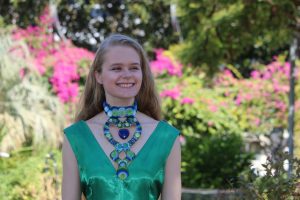
Kate graduated from the Bachelor of Music last year, and is now undertaking an Honours degree. The talented violinist said she was honoured to receive the Medal for Excellence.
“I was so surprised- it’s very exciting,” she said.
“I’vebeen playing violin since I was eight years old – it can be incredibly challenging, but also rewarding.
“It is fantastic to receive this kind of recognition.”
Originally from Adelaide, Kate travelled halfway across the country to study at the Queensland Conservatorium with Michele Walsh – one of the country’s best violin teachers.
“After high school, I was tossing up a few different options, but I realised it was now or never for music,” she said.
“I got to know Michele through the Australian Youth Orchestra, and she is the reason I decided to come up to Brisbane to study at the Con.
“She is absolutely wonderful and we all adore her – Michele brings out the best in all her students.”
During her time at the Queensland Conservatorium, Kate has founded several ensembles, and played to diverse audiences as part of projects like Opera at Jimbour, Griffith Opera on the Beach, and regular performances at the Lady Cilento Children’s Hospital.
“The priority here isn’t just getting good marks, it’s about developing as a musician and giving something back,” she said.
Fellow medalist Crystal Smith has also gone ‘above and beyond’ during her time at the Queensland Conservatorium – from mentoring younger students, to volunteering as an accompaniest at student recitals, and providing regular entertainment to patients and their families at the Lady Cilento Children’s Hospital.
Crystal has also broadened her musical horizons – creating several chamber ensembles, playing with the Conservatorium Symphony Orchestra and collaborating with music technology students on a series of experimental works.
Crystal has been playing piano since she was five years old, and comes from a large, musical family. While she spends up to 10 hours a day practicing, she also relishes the opportunity to use her music to give something back.
“Playing piano can be quite a solitary pursuit, but I realised after coming to the Con that there is a much bigger world out there,” she said.
“This whole building is full of incredible musicians, and I decided to break out of the practice studio.
“You may have to sit for hours on end mastering your instrument, but music is about community – it’s the universal language.”

 Last year’s Federal Budget produced an unwelcome surprise for the major banks in the form of the Banking Levy. The cries of pain from those affected are now long since forgotten and any remaining sympathy for their situation has dissipated given what has been uncovered by the Royal Commission into Misconduct in the Banking, Superannuation and Financial Services Industry. With the Commission revealing what is seemingly a systemic problem in the industry, attention has now turned to whether and how the banks and other major financial institutions might be penalised and further regulated.
 1999 was a great year to be alive in Australia. Apart from Prince hitting the airwaves again, Powderfinger were still playing and topped the Hottest 100, the first Matrix movie was released, and you could still get a flat white for under three dollars. In terms of the Federal Budget, 1999 marked the start of a remarkable period in which the Federal Budget accumulated approximately $90 billion dollars between 1999-2008.
 These phases of fiscal recovery coincided with a significant upward jump in the commodity prices. The only period where the fiscal position improved in the absence of rising commodity prices was immediately after the 1992 recession.
 As well as being a keen singer, Nicole first started penning her own compositions as a teen.
 Dr Irene Bartlett said Nicole was a rising talent in the international music scene.
 Head of Griffith Film School Professor Herman Van Eyken said it was gratifying to see GFS graduates sweep the pool of entries.
 Griffith Film School graduate Josh Long was selected for last year’s program, and had his short horror film, Post Mortem Mary, screened at Screamfest in LA. He will mentor this year’s SQ Shorts winners.
 Griffith Film School graduate


 Kate graduated from the Bachelor of Music last year, and is now undertaking an Honours degree. The talented violinist said she was honoured to receive the Medal for Excellence.
 Fellow medalist Crystal Smith has also gone ‘above and beyond’ during her time at the Queensland Conservatorium – from mentoring younger students, to volunteering as an accompaniest at student recitals, and providing regular entertainment to patients and their families at the Lady Cilento Children’s Hospital.