Griffith University is pleased to announce the appointment of Professor Peter van Onselen to the Griffith Business School as Professor of Politics and Policy
Professor van Onselen brings to Griffith extensive experience in the fields of politics and journalism, including that garnered through his role as Foundation Chair of Journalism at the University of Western Australia and several years as a presenter on Sky News.
In addition to his academic credentials, Professor van Onselen has also been a contributing editor with The Australian since 2010, written for a diversity of other well-known national mastheads including The Sydney Morning Herald and The Age, and he delivers a weekly segment on ABC Radio National.
He is also a regular fixture of local screens, appearing fortnightly on ABC’s The Drum and as a regular panellist on Insiders.
Earlier this month, Professor van Onselen preceded his official appointment with the University as the moderator of a Griffith-hosted Q&A session with Federal Labor MP Jim Chalmers.
Griffith Business School Pro Vice Chancellor Professor David Grant said Professor van Onselen’s appointment was an obvious coup for the University.
“ProfessorVanOnselenis a well-known political commentator and highly regarded academic in his discipline. His research record includes authorship of 6 high-profile books.
“His part time appointment at Griffith will build further on the engagement and impact activities of GBS. Peter’s teaching into the MBA and GCPA programs, as well as undergraduate teaching, will complement his continuing program of academic research,” Professor Grant said
Two of the best names in urban planning took out high honours at a national awards night held in Perth recently, and both are from Griffith University.
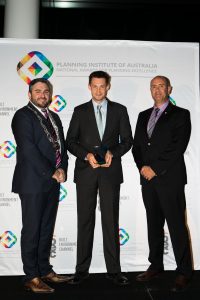
Dr Tony Matthews from Griffith’s Cities Research Institute accepted the award for Cutting Edge Research and Teaching for his role in the popular radio show and podcast The Urban Squeeze, and graduate Thomas Gardiner won the prestigious Young Planner of the Year award at the Planning Institute of Australia’s (PIA) National Awards for Planning Excellence on May 9.
The Urban Squeeze accolade follows hot on the heels of the podcast’s wins last November at the PIA Queensland event where it also won the Cutting Edge Research and Teaching gong as well as the Overall Award for Planning Excellence.
The podcast’s two seasons of 28 episodes featured Dr Matthews and former Griffith academic Professor Jason Byrne, and were broadcast live on Matt Webber’s ABC Drive show from 2016-2017. Dr Matthews said there is a strong possibility of a third season in the future.
“The strength and success of The Urban Squeeze is that we demystified a huge number of questions about why certain things happen in cities and don’t happen in cities, and it spoke very directly with people who live that experience,” Dr Matthews said.
Dr Tony Matthews with his award for podcast The Urban Squeeze.
“Questions like why are you stuck in traffic? Why are you living in an area that is not well serviced by community infrastructure? Why are we building so many apartments? What’s the value of greenspace? So it really spoke to those people living those experiences in the urban setting, which is 90% of people in this country.
“It’s always a pleasure to be able to talk about what you do professionally to a wider audience and have them actually be interested. And to now get the professional recognition with these awards tells us that our peers like what we’re doing also.”
Thomas Gardiner graduated Griffith in 2014 with a double degree – a Bachelor in Urban Environment and Planning and Bachelor in Science and Environment – with first class honours.
He is now the Senior Planner for Rockhampton Regional Council and oversees a small team in the review of development applications lodged to council.
“A big part of my role is delivering positive planning outcomes for the Rockhampton region, and the core of trying to deliver those good outcomes is engagement, working with the community and involving all stakeholders,” Mr Gardiner said.
“I had no idea I was getting the award until they announced my name on stage. While the award itself was a really good personal accolade, it was a really strong confirmation from the institute that you can do wonderful things in your career as a young professionals.
“It was very nice for the Planning Institute to recognise that young planners can go out into the region and advance their careers.”
About Planning Institute Australia
Planning Institute of Australia (PIA) is the national body representing planning and the planning profession. Through education, communication and professional development, it is the pivotal organisation serving and guiding thousands of planning professionals in their role of creating better communities.
Urban Squeeze Radio Show Jason Byrne MPIA and Tony Matthews PIA (Assoc.) (Griffith University), Karin Adam and Matt Webber (ABC Radio, Gold Coast, 91.7FM) Award Winner – Cutting Edge Research & Teaching 2018 National Judges’ Citation The Urban Squeeze radio show is a truly visionary and innovative approach to teaching methodology, as well as a unique means of engagement with the community on the value of planning. The radio show shifts discussion with the community about land use planning from the emotive, parochial and reactive; to a considered and informed baseline understanding of the drivers, context and theories that shape planning practice. Coupled with its role of engaging research students in dialogue on planning practices and principles in an informative and easily accessible media, the carefully curated radio show boasts a diverse audience of approximately 26,000 listeners per episode, plus past episodes are available on the internet. The radio show, soon to enter its third season, entertains plentiful opportunities for future application and ongoing engagement with planning practitioners, scholars and the community which is applicable in the local, state and national contexts. In an award category with excellent entries from around Australia, the Urban Squeeze Radio Show is a truly deserving recipient of this award.
Thomas Gardiner
Thomas Gardiner MPIA Award Winner – Young Planner of the Year 2018 National Judges’ Citation Planners of all ages, but especially those beginning their careers, are well advised to look to Thomas Gardiner for an example of the rich diversity of professional and personal experiences that regional employment can provide. Thomas demonstrates a level of lateral thinking as a young planner, which in some ways may have become counter-intuitive to the direction of mainstream planning thinking. This broad perspective to both his craft and the way he builds professional relationships comes at a time when many rural areas are challenged by dealing with a deepening complexity of issues around globalisation, economic diversity and the health of rural communities. Notwithstanding these challenges, Thomas’s natural tendency to remain positive and “hit the ground running” when presented with unique opportunities, has already given him the knowledge and experience to speak with authority on rural and regional issues. His presentations as a young planner practising in the regions convey the passion and insight which have made people listen and realise some of the virtues of a strong regional and rural sector, as well as the benefits that come from practicing in this field. Thomas has achieved highly in his time in the profession and will undoubtedly achieve much more to the benefit of all. He has had a significant impact on those he has met and worked with, and he has demonstrated initiative and drive, well above what may be expected from his role in a regional setting.
Griffith University will once again show its community support and engagement as a partner of the Advancing Regional Innovation program at this month’s Myriad Festival.
The program sees the university engage with both Redland and Logan city councils — along with seven other partners – to highlight the game-changing work being done by a group of innovative regional start-ups and entrepreneurs.
Hologram makers BOP Industries, device management firm EC Connect, fellow program partners Substation 33 and the Community Care Smart Assistive Technology Collaborative will showcase at this pinnacle event.
“The aim of the Myriad Regional Delegation Showcase is to demonstrate the very real ways in which these entrepreneurs and start-ups are making an impact on the world around them,” Griffith Business School Yunus Innovation Programme Manager Ms Celeste Alcaraz said.
“These companies typify a core value of fostering creative, connected, engaged and sustainable communities through their actions, and the showcase will provide a chance for them not only to raise awareness about what’s happening in the local innovation space, but to promote the thriving Logan/Redlands region at large.”
Other businesses comprising the Redlands/Logan delegation for the ARIP program include Brisbane-based robotic solutions company Freelance Robotics, agricultural input purchasing digitisers STOCR, electricity access advocates Powerwells, Wi-Fi visionaries Switchnode, vertical garden purveyors Space Plants Pty Ltd and conflict resolution specialists Adieu.
“Griffith University’s Logan campus has earned a reputation for community and industry engagement in the Logan/ Redlands region,” Ms Alcaraz said.
“Our involvement as an Advancing Regional Innovation partner speaks to the University’s ongoing commitment to supporting entrepreneurship and innovation in the local community. We wish this year’s delegate companies the best for their showcase experiences.”
The annual Myriad Festival brings together the world’s most influential thinkers and entrepreneurs for a three-day celebration of creativity and innovation.
This year’s event, which prides itself on the sharing of information and learning more about globally focused innovative programs and opportunities, focuses on seven key themes: Cities, Health, Food, Money, Work, Play and Culture.
Griffith’s presence there extends beyond its Innovation program partnership, with alumnus and Shoes of Prey co-founder Jodie Fox scheduled to deliver a speech on the future of culture on Thursday 17 May.
In addition, new online experience gifting platform NoExpiry, co-created by a group of Griffith graduates, will be launching during the festival.
The 2018 Myriad Festival is an initiative of Advance Queensland, and will be held at the RNA Showgrounds from 16-18 May.
The biennial acquisitive prize is open to artists from across the country, attracting hundreds of entries.
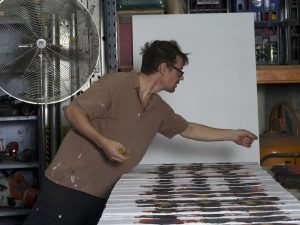
Robert took out top honours with his work ‘Whitewash over the burn’, a striking textural piece that features burnt timber boards, aluminium, ochre and chalk.
Robert said he couldn’t believe his luck when a call came through from this year’s judge, Brian Ritchie – MONA FOMA curator and Violent Femmes bassist.
“It was a major surprise – I was absolutely speechless,” he said.
“The money will give me the opportunity to keep making art, and winning a prize like this also helps get your work out there and seen by a wider audience.”
Photo credit: Carl Warner
Robert’s prize-winning work was a tribute to his great-grandmother, a Yawuru woman from the Kimberley region whose struggles to gain citizenship in the early 20th century inspired the piece.
Robert took wooden panels from his colonial-era house in Brisbane, which were embedded with text from his great-grandmother’s repeated applications for citizenship and the subsequent denials. After burning the boards, Robert doused them with ochre and covered them with white chalk.
“Often historical documents were intentionally burnt to destroy and cover up atrocious acts against Indigenous people, and I used this process of burning to enact mirror this form of violence back upon the English text as a cathartic strategy,” he said.
Queensland College of Art Director Professor Derrick Cherrie said Robert was enjoying a career-defining year.
“This national award attracts some of the country’s best artists,” he said.
“Robert’s richly layered, complex work deservedly took out top honours.
“His work is concerned with repressed histories and the traumas of colonisation suffered by Indigenous peoples in this country.
“As well as the significant prize money, it represents an opportunity for him to present his work to some of the country’s most renowned curators.”
Professor Cherrie said Robert was one of many remarkable artists to emerge from the QCA’sContemporary Australian Indigenous Art (CAIA) program, with an impressive roll call of graduates including Vernon Ah Kee, Tony Albert and Dale Harding.
“The fact that our CAIA students and alumni are receiving recognition at high profile national and international awards reflects the calibre of this unique program.”
The Alice Prize finalists exhibition is on at theAraluen Arts Centre in Alice Springs until 17 June.
Queensland Conservatorium musical theatre graduate Shubshri Kandiah has had all of her wishes granted after winning the lead role of Princess Jasmine in Disney’s smash hit musical Aladdin.
The role will mark Shubshri’s professional musical theatre debut. The 22-year-old graduated from the Bachelor of Musical Theatre at the end of last year, and is now the star of the country’s biggest show.
She will play Princess Jasmine for the final weeks of the Brisbane run at the Queensland Performing Arts Centre (QPAC), before wowing audiences in her hometown, Perth.
“I found out through my agent who flew to Brisbane and caught up with me over coffee. I was pouring honey into my chai when my agent broke the news and the honey just went all over the table!
“I was excited but a part of me didn’t really believe it. There are still times when I feel like its not real and I’ve now been rehearsing the role for two weeks.
“It is a dream come true to be chosen by the international creative team. They’ve shown a lot of faith in me and I will strive to give my best on stage.”
Shubshri has always been a fan of Disney’s classic movie musicals, and had a special connection to Aladdin.
“It was the first film with a princess on screen who looked like me. And now to bring that character to life on stage is an incredible experience,” she said.
“As a kid I saw Jasmine and wanted to be like her because she was a beautiful Disney princess but as an adult I really admire her strength, intelligence and that she is never afraid to voice her opinion.
“She is what I see a strong woman to be and I’m so excited to step into her shoes and learn from her.”
Shubshri began performing at a young age, learning classical Indian dance, ballet and violin. She moved across the country from Perth after being accepted into the Queensland Conservatorium’s renowned Bachelor of Musical Theatre.
During her studies, Shubshri dazzled audiences in productions like Sweet Charity and West Side Story, and was a featured vocalist with the Queensland Pops Orchestra.
“My three years studying at the Queensland Conservatorium provided me with so many skills that I have taken with me,” she said.
“From voice warm-ups to script analysis, dance technique and a knowledge of vocal health that will allow me to perform eight shows a week – I felt more than prepared for a career in the industry.”
Queensland Conservatorium Head of Performing Arts, Associate Professor Paul Sabey, said Shubshri was always destined for great things.
“Her talent was evident from day one, and she has the drive and dedication to make it in the industry,” he said.
“She is a performer who is able to reach every audience member through her performance, which is a rare quality.
“The role of Jasmine is a perfect fit, and we wish her every success.”
Queensland Conservatorium Director Professor Scott Harrison said that fostering close ties with organisations like the Queensland Performing Arts Centre had opened up remarkable opportunities for students like Shubshri.
“We are fortunate to be based in the heart of Brisbane’s cultural precinct, and our relationship with organisations like QPAC mean that our students enjoyincredible opportunities to learn from industry professionals and perform alongside the world’s best artists.
“Shubshri had the opportunity to undertake workshops with Broadway legend Liz Callaway as part of our partnership with QPAC,” he said.
“She was chosen to perform a duet with Liz, and that performance put her on the radar of the Disney creative team – the rest is history!”
Aladdin has established itself as one of the biggest new blockbusters in recent years, playing to more than six million people worldwide.
Produced by Disney Theatrical Productions (The Lion King, Mary Poppins), Aladdin features music by Tony Award and eight-time Oscar winner Alan Menken (Beauty and the Beast), lyrics by two-time Oscar winner Howard Ashman (The Little Mermaid), three-time Tony Award and three-time Oscar winner Tim Rice (Evita).
‘Realising Career Potential:Rethinking Disability’ is a free MOOC (Massive Online Open Course) now open for enrolment that enables learners to see how rehabilitation counsellors help people with disadvantage or disability realise their vocationalpotential.
Griffith University’s Rehabilitation Counselling and Case Management experts,Dr Vanette McLennan and Dr Christine Randall lead the global discussion on the benefits of enabling people with disadvantage or disability to participate fully in society.
“Unfortunately there are many misconceptions regarding what disability actually is and what the barriers are for people with disability in the workplace and in the community. Discrimination and stigmatisation are still huge barriers for people and through this course, we want to challenge the myths and assumptions that exist.
“People don’t realise how much workplaces and communities benefit when everyone has the opportunity to participate fully in our society. Too often, misconceptions about disability get in the way. Workplace attitudes, flexibility and technologies can make a real difference.
Participation for all
“It’s about raising awareness of the importance of participation for all,” says Dr McLennan.
“By looking at real-life case scenarios, including people with physical disabilities as well as those with less visible disabilities, we can help course participants to challenge assumptions and rethink what is possible for people with disability in their communities and workplaces.”
Available on FutureLearn, the social learning platform, ‘Realising Career Potential:Rethinking Disability’ will connect individuals from around the world to come together to discuss key issues in disability today. They will hear from Griffith University experts on how they can be part of a global movement to promote more equal access to community participation and meaningful employment for people with injury, disability and disadvantage.
The course is available to join from May 14 and takes around three hours per week to complete, though learners can complete the course at their own pace. The learning modules are in bite-sized chunks and available 24/7 to enable flexible study.
Dr McLennan added: “The course is designed for anyone concerned about disability, including health professionals, students and researchers, as well as people with disability. It’s also a great opportunity for people who want to explore the role of the Rehabilitation Counsellor in helping clients realise their career potential after injury or illness.
“We provide learners with the knowledge and skills to enable them to make a difference. Using a wide range of interactive learning methods such as videos and discussions, we explain the case for improved workplace and community participation and how everyone is able to contribute.”
The course‘Realising Career Potential:Rethinking Disability’ is open for enrolment now and is due to begin 14 May. If you want to embrace diversity and rethink disability — why wouldn’t you? More details here.
As with most FutureLearn courses, the course can be taken for free or there is the option to upgrade to receive additional benefits.
About FutureLearn
Founded by The Open University in 2012, FutureLearn is a leading social learning platform, enabling online learning through conversation. With over 7.5 million people from over 200 countries across the globe — a community that is continuously growing — it offers free and paid for online courses from world-leading UK and international universities, as well as organisations such as Accenture, the British Council and Cancer Research UK. FutureLearn’s course portfolio covers a wealth of areas to promote lifelong learning for a range of applications including general interest, an introduction to university studies, continuing professional development and fully online postgraduate degrees.
Helping young women live well after a cancer diagnosis is the aim of a new program being developed by members of the Women’s Wellness Research Group at Griffith University.
Led by Professor Debra Anderson from Griffith’sSchool of Nursing and Midwifery and the Menzies Health Institute Queensland, the 12-week nurse-led intervention provides a structured eHealth lifestyle program designed to support women aged 20-40 years with cancer, and minimize lifestyle-related health risks.
“Younger women with breast, blood and gynaecological cancer need targeted and tailored health promotion programs as they can experience some unique health concerns after cancer treatment,” says Professor Anderson, who speaks this week in the lead up to International Nurses Day (Saturday 12 May).
“Younger women with cancer can experience some specific concerns associated with these types of cancer. Depending on the age group, these may include fertility concerns, treatment-induced menopausal symptoms, weight gain, body image issues and concerns about sexuality and intimacy.
“We found that women in this age group reported reduced physical, social and emotional wellbeing and almost half reported significant concerns about sexuality and partner intimacy.
Unmet needs
“Younger women with cancer often report unmet needs and health education, and health promotion programs designed specifically for them is limited. This may make this population particularly vulnerable to anxiety and depressive symptoms.
“Women’s distress associated with their unmet needs can influence treatment adherence, survival, quality of life, and feelings of satisfaction with care received. The effects on family and the broader community are also significant.
“It is timely that we are expanding the program with the aim of trialing it nationally.
“By providing an intervention that taps into the specific needs of younger women specifically, we anticipate greater uptake of the intervention, improved lifestyle behaviors, better quality of life and increased self-efficacy.”
Breast and gynaecological cancers accounted for around 28% and 10% of all new female cancer cases in 2017, of which around 6% occurred in women aged under 40.
The woman behind an albatross conservation project was just one of the winners at this year’s National Climate Change Adaptation Conference held at the Crown Promenade in Melbourne.
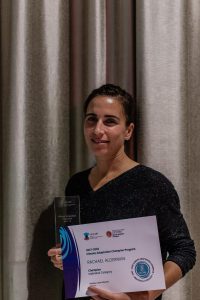
Dr Rachael Alderman from Tasmania’s Department of Primary Industries, Parks, Water and Environment was crowned a Climate Adaptation Champion by Griffith University’s National Climate Change Adaptation Research Facility (NCCARF) at the biennial awards ceremony on May 9.
Dr Rachael Alderman from Tasmania’s Department of Primary Industries, Parks, Water and Environment was crowned the Individual winner.Credit: Renee Chapman Photography
The award recognised Dr Alderman’s vital work to increase shy albatross numbers using innovative methods to help counteract the in effects of climate change, including artificial nests and disease treatments.
“We still have a lot to learn about how climate change will affect the shy albatross into the future but we know enough to know that it is a problem, so this work aims to develop tried and tested techniques that can be used to give the birds more resilience to cope with climate change,” Dr Alderman said.
“What I like about this award is that it’s saying with creative thinking like this, we can have really positive outcomes especially as we face the daunting challenges around climate change, conservation and extinction.”
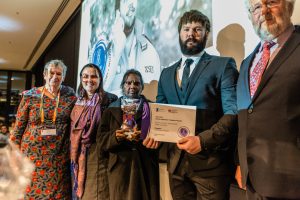
The awards also honoured the achievements from businesses and government groups, with Donovan Burton from Climate Planning taking out the Business category and Wujal Wujal Aboriginal Shire Council topping the Government category.
This is the sixth round of Climate Adaptation Champions that have been awarded by NCCARF since 2011.
Members of the Wujal Wujal Aboriginal Shire Council, who took out the Government category. Credit: Renee Chapman Photography
The National Climate Adaptation Conferences are the major Australian forums focused exclusively on climate vulnerability, impacts and adaptation and attract up to 400 practitioners and researchers from around Australian to share experiences and showcase activities, strategies and research.
Griffith University’s NCCARF Director Professor Jean Palutikof says the award winners have shown their commitment to pursue initiatives and take real action towards climate change adaptation.
“NCCARF’s Climate Adaptation Champions show we can do something about climate change. Our Champions take local action to address local changes, and together their actions sum to something important that makes a difference to Australia’s vulnerability to climate change,” Professor Palutikof said.
Climate Adaptation Champions for 2017-2018 are:
Business category Donovan Burton, Climate Planning: Climate planning has been in operation for over a decade and has undertaken over 150 climate change adaptation projects with a broad array of sectors. Informed City is Climate Planning’s lead product designed to shape policies and influence change at a rapid rate. The tool is designed to assist governments to manage the direct, indirect and transitional risks and opportunities that climate change presents. Government category Wujal Wujal Aboriginal Shire Council: The Wujal Wujal valley-wide Emergency Management Network and Community Forum provides those working and living within the Community a means of telecommunications which is wind and rain resistant, robust and with sufficient capacity to enable Council, Local Police, Health Services and volunteers to manage conditions pre and post emergency event when and if normal telecommunication systems are compromised. Individual category Rachael Alderman, DPIPWE Tasmania: Rachael has pioneered a new climate and conservation philosophy within her Tasmanian conservation agency, DPIPWE. Rachael has led the long-term monitoring for the endemic shy albatross on its three breeding colonies for some 15 years, which provided a unique data set for understanding the climate risk for this iconic species. She was involved in a range of analyses that showed that the species would decline in future without intervention, and then worked hard to obtain permits to undertake the first climate intervention experiments on this iconic species.
Eminent contemporary artist and Griffith University alumna Davida Allen delighted the audience at a special screening of her acclaimed 1999 film Feeling Sexy at Griffith Film School.
Held to coincide with Griffith University Art Museum’s current exhibition Davida Allen: In the Moment, the night included a Q&A with Allen and the film’s producerGlenys Rowe where the two shared anecdotes about their careers and the film’s production.
Allen, who wrote and directed the film, spoke about what attracted her to adapting her art practice to encompass the cinematic, as well as her short novelClose to the Bone : The Autobiography of Vicki Myers, on which the film is loosely based.
“I’d been directing my children and husband for years” she said. “The book was published to a specialised audience, but I wanted to bring the story to the ordinary person. It was greed for an audience really.”
Rowe, a former General Manager of SBS Independent, spoke about meeting Allen for the first time over a spontaneous lunch at the artist’s home. “On the wall in Davida’s house was a painting of three little girls in a happy beach scene, with huge filthy black writing in the sand saying ‘WHAT IF THERE’S A SHARK'” she said. “When I saw that saw that painting with the image counterpointed with what I read as sound, I knew that Davida could make a film because that was a complete scene.”
Seeing the film 20 years on was an extraordinary experience for both Allen and Rowe, made even more fascinating by its recent remastering from celluloid to digital.
“It’s weird because the film doesn’t seem that old” said Allen. “At the time I was quite vulnerable because it was my specific point of view, so it’s good to see it holds up well as a story now.”
Many of the film’s original crew were present for the trip down memory lane, including the now internationally-renowned cinematographer Gary Phillips. Allen said that having so many faces from the set in the audience was like being surrounded by family after such a close personal experience.
“Being surrounded by all these people there to help you with your vision, to do everything for you but do it even better than you can do yourself…it’s like heroin in your veins seeing it brought to life” she said. “I’m too old to make another film now, but that feeling is like an addiction.”
In 1986 Allen won the Archibald Prize with a candid portrait of her father-in-law, and in 2010 won the Tattersall’s Club Landscape Art Prize. She was awarded a Doctor of the University, GriffithUniversity, in 2004 in recognition of her long association with Queensland College of Art – first as a student under Roy Churcher, then a teacher in the mid 1990s.
Davida Allen: In the Momentat Griffith University Art Museum is the first survey of Allen’s practice in over 30 years, and includes seminal works from her career such as theDeath of My Fatherseries andSam Neill Suite, as well as her Archibald Prize-winning paintingMy father-in-law hosing his celtis trees1986. The exhibition runs until 30 June 2018.
Photograph: Thomas Oliver
With the 2018-19 Federal Budget freshly released, Griffith University asked some of its foremost experts about a range of crucial social and political issues to offer their analysis of the shape Treasurer Scott Morrison’s ledger has taken.
See below for a summary of key cornerstones of this year’s Budget, and use the links to read more commentary from our academics.
Dr Andreas Chai — Overview
1999 was a great year to be alive in Australia. Apart from Prince hitting the airwaves again, Powderfinger were still playing and topped the Hottest 100, the first Matrix movie was released and you could still get a flat white for under three dollars. In terms of the Federal Budget, 1999 marked the start of a remarkable period in which the Federal Budget accumulated approximately $90 billion dollars between 1999-2008.
2018 is starting to look a lot like 1999, at least in terms of international commodity prices. While global growth remains sluggish and domestic business investment is stuck in a low gear, the underlying cash balance of the Federal Government is projected to reach surplus in the coming quarters thanks to the strong performance in commodity prices, such as an iron ore.
The context of this federal budget is characterised by a favourable alignment of political and economic incentives. Given 2018 is an election year, the political incentive for the government is to strengthen its consensus by adopting “expansionary” budget measures such as lowering taxes and increasing expenditure (possibly targeted to key constituencies). At the same time, with the Australian economy still running below potential, these same expansionary measures will help stimulate aggregate demand and close the gap between actual and full-employment potential Gross Domestic Product.
This alignment of incentives means that the government does not have to choose between what is good for the economy and what is politically convenient.
Professor David Grant — The Banks and Financial Services
Last year’s Federal budget produced an unwelcome surprise for the major banks in the form of the Banking Levy. The cries of pain from those affected are now long since forgotten and any remaining sympathy for their situation has dissipated given what has been uncovered by the Royal Commission into Misconduct in the Banking, Superannuation and Financial Services Industry. With the Commission revealing what is seemingly a systemic problem in the industry, attention has now turned to whether and how the banks and other major financial institutions might be penalised and further regulated.
Against this background, the 2018 budget becomes all the more interesting; not because it does anything to single out the banks and others in the financial services sector for special (punitive) treatment as a response to their wrongdoings highlighted by the Commission, but rather because the budget is likely based on economic modelling and forward estimates that assume the sector to be in robust financial health. And that is a potential problem.
Although the 2018 budget has been portrayed as one which seeks to shore up electoral support for the government in the context of an impending election, there is not a great deal of additional money being promised for expenditure programs in non-metropolitan Australia.
There is a continuation of the Building Better Regions Fund, the Stronger Communities Program, the Roads to Recovery Program, the Black Spots Program, the Bridges Renewal Program and the National Highway Upgrade Program. However, there are no major increases in funding for these programs in the 2018-19 financial year.
There have been a number of major infrastructure projects announced and these will be very much welcome in the affected regions; however, the majority of the big-ticket items in this area are targeted at congestion-busting in greater metropolitan regions.
The problem with funding for cities is that it’s everywhere and nowhere. A great range of spending measures have an impact in and on cities, whether in terms of direct spending on urban infrastructure or less directly on people who happen to live and work in cities, and that represents about 90% of us.
But is that spending on public services and investment in infrastructure guided by a national policy for cities? Unfortunately, no.
The 2018 Federal Budget endorses another positive year of outlays for the Defence portfolio and security more broadly. The Defence Portfolio Budget Statement confirms that the Turnbull Government has authorised growth in real terms, which equates to 1.9% of GDP.
The Abbott Government’s commitment in 2014 to endorse an expenditure target in the Defence portfolio of at least 2% of GDP per annum by 2020-21 has meant this area of the budget has effectively been ring-fenced from cuts. The ambitious strategic guidance laid out in the 2016 Defence White Paper (DWP), coupled with signs of a deteriorating security environment in Asia, has reinforced the logic of this in the eyes of senior policy makers, and it’s unlikely this would change in the event a Labor Government was elected.
Associate Professor Albert Gabric – Great Barrier Reef
Researchershave recognised for over 25 years that poor water quality due to land use change and farming in the coastal hinterland is fundamentally incompatible with a healthy coral reef ecosystem.
The language in recent reports mentions maintaining and improving the reef’s resilience, even though the general concept of ecosystem resilience is difficult to define and even more difficult to measure.
The proposed Budget allocation of $500 million, while certainly welcome, is a very small step in confronting a classic “wicked problem”, which is by definition extremely difficult or impossible to solve.
The 2018-19 Federal Budget has the opportunity to make a social impact on equity, safety and restitution to people disadvantaged structurally by violence. Over the past five or so years, there has been significant attention to ravages of violence and abuse, particularly on children and women across the life course. The costs to society and restraint on human potential can never be underestimated.
History will see this era as revolutionary in awareness, but will it be disappointed by action? The Federation of Australia has a rare opportunity to say it has learnt from the past by showing it is acting for the future by resourcing innovation to prevent and respond to violence.
Long-term unemployment in Australia has increased since the Global Financial Crisis, ticking up from 14.8% of the total unemployed in January 2008 to 23.8% in March 2018 (Australian Bureau of Statistics). These figures mask (i) geographical variations whereby long-term unemployment is more pronounced in regional areas, (ii) age profiles, with older unemployed Australians finding it harder to gain employment, both of which are partially attributed to (iii) structural change within the Australian economy that has eschewed manufacturing and more labour-intensive jobs requiring less formal education to a more services-oriented economy that increasingly favours the educated and indeed female labour market entrants.
Thus, governmental response needs to be multi-faceted. Re-training programs have been a global staple of government intervention in equipping the longer-term unemployed to find work but it is a policy that has evinced very mixed results. A more holistic package of ‘re-inventing’ the long-term unemployed is needed, one which provides the recipient with a host of options to choose from.
The 2018 Federal Budget includes incentives for the energy sector with the further development of coal, oil and gas. However, a lack focus on oil security diverts energy policy debate away from the availability of our energy supplies and onto back-pocket affordability. Oil supplies barely rated a mention in the 2018 Budget.
But,despite repeated warnings via the 2004 Energy White Paper and the more recent 2016 Defence White Paper, Australia has not maintained a sufficient oil reserve for 80 of the last 91 months.Despite the recent rediscovery of this issue by members of the government, little has been done in the past 14 years to increase our strategic oil supplies.

 Queensland College of Art Director Professor Derrick Cherrie said Robert was enjoying a career-defining year.
 Queensland Conservatorium Head of Performing Arts, Associate Professor Paul Sabey, said Shubshri was always destined for great things.
 Queensland Conservatorium Director Professor Scott Harrison said that fostering close ties with organisations like the Queensland Performing Arts Centre had opened up remarkable opportunities for students like Shubshri.