This Wednesday 10 October, is World Mental Health Day and, as a leading institution in the field, Griffithhas a range of expertise and programs which link to thisyear’s theme, ‘Young people and mental health in a changing world’.
The aim is to bring attention to the issues our youth and young adults are facing in our world today andbringthe conversation around what they need in order to grow up healthy, happy and resilient.
ProfessorAllisonWatersis an expert incognitive and learning-related mechanisms and novel interventions for youth anxiety disorders. Shehas been running the Griffith University Childhood Anxiety Disorders Research Program since 2004, initially based at the Gold Coast campus and now based at the Brisbane campus at Mt Gravatt.
“During this time, more than 500 children between 4 and 13 years of age with high levels of anxiety have been assessed and/or treated through the Program using well-researched diagnostic and assessment tools and evidence-based treatments,” says Professor Waters.
Improving the sleep of pre-schoolers to reduce the risk of child mental health and academic problems is the goal of a new program bythe university’sSchool of Applied Psychology.
Deliveredat psychology clinics at universities in Adelaide, Brisbane and the Gold Coast as part of a research trial, theLights OutProgram is a series of small group workshops for parents of children in the year before they begin Prep/Reception.
“Sleep problems in the pre-school years represent a risk factor for numerous child mental health problems and academic problems, in the short and long-term,” says study leaderAssociate Professor Caroline Donovan.
“Given that sleep problems are modifiable, it follows that successful treatment BEFORE children begin primary school will reduce child sleep and mental health problems, improve the transition to primary school, and enhance academic outcomes.”
Meanwhilethe world’s first long-term assessment of mental health effects from adolescents’ late-night mobile use has shown some concerning results.
Research conducted byGriffithand Murdoch University tracked changes in late-night mobile phone use, sleep, and mental health indicators over three years in a large sample of Australian teens.
They found that adolescents’ late-night mobile phone use was directly linked to poor quality sleep, which subsequently led to poorer mental health outcomes, reduced coping, and lowered self-esteem.
“What is especially compelling” saysDr Kathy Modecki, “is thatincreases in poor sleep, in turn, led to rises in depressed mood and externalizing behaviours, and declines in self-esteem and coping one year later”.
Suicide Prevention
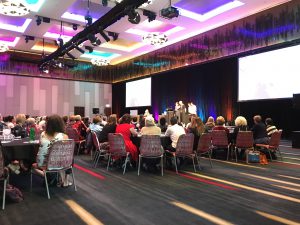
Griffithis highlyactive in the field of suicide prevention, witha wide range of academic research taking place attheAustralian Institute for Suicide Prevention and Research(AISRAP). The Institute alsorecently hosted its annual World Suicide Prevention Day Forumon September 14.
Supported by the Queensland Mental Health Commission,theforum was held at South Brisbane’s Greek Club with thisyear’stheme of“Working Together to Prevent Suicide”.
AISRAP Research Development ManagerWendy Iversonsaid the event,theaimof which istoraise awareness ofsuicideand to develop prevention strategies, was aresoundingsuccess.
“It was a really excellent day, with 200 delegates, and it wasterrific to see the engagement fromsuch a broad range of community.”
The forum included an opening address from Queensland Mental HealthCommissioner IvanFrkovic, as well as presentations from researchers in the suicide prevention field, organisations that support at-riskindividuals and their familiesand people with a personal experience of suicide.
Studymental health
If you have an interest in people and the ability to relate to others, together with good communication skills, a career in the mental health area could be the right choice for you.Griffith has a range ofstudy optionscovering mental health practice and suicidology.
Earlier this year AISRAPMasters of SuicidologygraduateJorgen Gullestrupwas named as the 2018 Winner of the 14th AnnualLiFEAward recognising excellence in suicide prevention by Suicide Prevention Australia.
Mr Gullestrup has been behind successful work reducing the high rate of suicide within the construction industry.
“Suicide and what can lead up to it is a very lonely and dark place for an individual to experience,” says Mr Gullestrup, who had his own personal experience of mental illness and suicide attempts during his early life.
Through his involvement with AISRAP, Mr Gullestrup made the decision to study for the Graduate Certificate in Suicide Prevention which then later led into undertaking the Masters of Suicidology in 2014.
Griffith academic Dr Parmendra Sharma will attend a high-level dialogue on capacity development and growth for the South Pacific’s communities in Fiji this December, highlighting the University’s growing influence in the region.
Dr Sharma, the program convenor for Griffith’s South Pacific Centre for Central Banking, has been invited by the International Monetary Fund to attend the two-day conference in celebration of the 25th anniversary of the Pacific Financial Technical Assistance Center (PFTAC), the IMF’s technical assistance centre for the region, established in 1993.
“I am honoured to have been invited to attend this high-level event in Nadi alongside some of the region’s foremost Ministers, Central Bank Governors, senior officials and policy-makers,” Dr Sharma said.
“The invitation signals acknowledgment of Griffith’s growing influence in the region, and provides a great opportunity to further promote and strengthen our own relationships — and indeed, the University’s profile and reputation — in the South Pacific.”
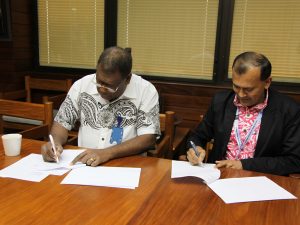
Governor Denton Rarawa (left) and Dr Parmendra Sharma sign the MoU between Griffith and the Central Bank of Solomon Islands.
Dr Sharma is no stranger to financial industry communities across the South Pacific, having spearheaded a series of Memoranda of Understanding (MoU)with several central banks in the region, including the Reserve Bank of Fiji, the Bank of PNG, the Central Bank of Solomon Islands and the Reserve Bank of Vanuatu.
He has also collaborated on working papers produced with central bankers in the region — attendees of a three-week Pacific Banking Fellowship convened by Dr Sharma and sponsored by the Department of Foreign Affairs and Trade — and is a previous attendee of the annual Meeting of the South Pacific Central Bank Governors.
His work in developing capacity and policy with the banks’ representatives highlights Griffith’s commitment to its role as one of Australia’s most Asian-engaged universities, and has been described by Griffith Business School Dean (Academic) Professor Fabrizio Carmignani as “a great example of what we can achieve when we engage with policy institutions”.
As a delegate at the event, Dr Sharma will take part in an agenda canvassing a range of opportunities and challenges for the South Pacific, including pathways for growth, public finances, capacity development, financial stability and new technologies.
The PFTAC’s 25th anniversary will be celebrated from December 6-7 at the Sofitel Denarau Resort in Nadi, Fiji.
The conference will involve more than 200 participants, and also entails a photo competition aimed at engaging aspiring young photographers aged 16-24 from 16 member countries of the centre.
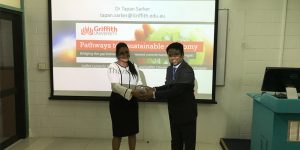
Dr Tapan Sarker presents a seminar at the Pacific Centre for Environment and Sustainable Development (PaCE-SD).
Pacific island countries show a unique combination of geographical, biological, cultural and economic characteristics. However, many of the Pacific island countries are extremely vulnerable to climate change. The islands are undergoing rapid urbanisation and the resulting increased population density magnifies the effects of events caused by climate change. Thus, developing a regional strategy for pacific island climate change services through effective engagement with key stakeholders is important in dealing with the Pacific challenges.
In a recent visit in Suva, Fiji, Dr Tapan Sarker, Director of Engagement of Department of International Business and Asian Studies engaged with government, university and private sector stakeholders to present and share ideas to help meet the Pacific challenges towards a sustainable future.
“It is great to have the opportunity to develop new projects in the area of sustainable development in the Pacific region,”Dr Sarker said.
Dr Tapan Sarker presenting his seminar at the MBA program at USP.
During his visit, Dr Sarkerpresented a seminar on building the business case for climate change adaptation at the Pacific Centre for Environment and Sustainable Development (PaCE-SD), which was opened in response to the region’s need for further research of the environment. The Centre aims to empower the people of the Pacific with the knowledge to be able to adapt to the impacts of climate change and pursue sustainable development.
He also presented a seminar on the role of climate finance and sustainable development in the Pacific at the MBA program at the University of the South Pacific, Fiji. The seminar was attended by business sector professionals and leading industry bodies in Fiji.
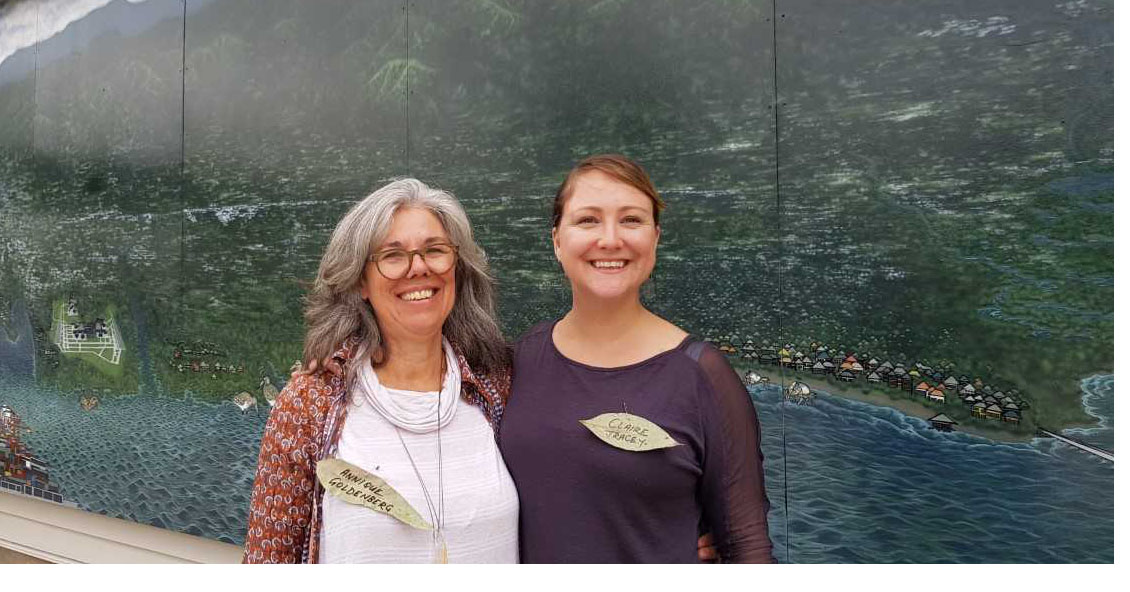
‘Flock’,is made from plastic bottles formed into aerodynamic shapes that represent a flock of birds in flight. The installation moves with the wind and waves and glows at night.
The artwork has been installedalong the foreshore at Nudgee, Manly and Sandgate and is part of a $40,000 public art commission by the Brisbane City Council to celebrate the 20th anniversary of the Brisbane-Narashino Wetland Agreement.
Claire and Annique are doctoral candidates at the Queensland College of Art, and both make work which focuses on the environment.
“We want to encourage audiences to think about humanity’s connection to the planet, by using materials like plastic rubbish, handmade paper and water,” said Annique.
“This artwork focuses on the human impact of plastic pollution on the wetland habitat of migratory bird species by using waste products to create something beautiful.”
Claire said that public art was uniquely positioned to tackle big ideas.
“Art can communicate complex ideas in a way no other medium can,” she said.
“I try and create work that makes people feel empowered to go out and do something to make the world a better place – I hope this installation makes people feel a responsibility for protecting the wetlands.”
The artwork makes use of new and innovative techniques in recycling and solar power.
As part of the project, Annique alsoworked with the​ ​local Bush​ ​Regeneration Volunteers and the Boondall Wetlands Environment Centre to collect weeds for a paper-making programme. The paper was used to create two hand-bound artist books for the Brisbane City Council and a delegation from Narashino.
The artwork was made at the Queensland College of Art, and staff and student volunteers from the QCAhelped with the construction and installation of this project.
“There is a wonderful sense of community at the QCA, and there is a real focus on sustainability,” said Claire.
“It’s a young university, and it really puts these big issues into the heart of its campuses.”
Flockcan be viewed at Nudgee Beach, Sandgate and Manly until 20 October.
Despite forecasts of rain this year’s Toohey Trail Run was the biggest yet with more than 1000 people taking part in the annual event hosted by Griffith Sport.
Griffith Sport Event ManagerJamie Hedgesaid it was wonderful to see so many people of all ages and abilities participate.
“We ended up having 1082 registrations which is a 10% increase on last year and raised over $6500 for Diabetes QLD,’’ she said.
Participants ran 5km, 10km or 21.1 routes from Griffith’s Nathan campus through Toohey Forest and back.
Brendan Press took out the 10km run in a time of 37.03, while Alison Ryan was the first woman home in a time of 46.07.
In the half marathon, Isaias Beyn was first in 1.19 while Clare Geraghty won the women’s in 1.31.
The Berrinba Running Team took the title as not only the biggest team at Toohey this year with 63 team members; they also took home the novelty prize for best team spirit cheering each and every member over the finish line.
Best dressed family went to Steph and Caitlyn Jansons.
Griffith University has surged clear at the top of the AON Uni 7s Series ladder after a powerful showing on the Gold Coast at the weekend. The Griffith girls made it back-to-back series wins after a gutsy showing in the gold medal match against University of Sydney.
The NSW side proved strong opponents and took the game to Griffith in the first half only to be repelled by an onslaught of ferocious tackling. Education student Kahli Henwood nicked the only try of the first half before Griffith started to turn the screw on the surprise finalists in the second half.
Doubles from Kirby Sefo and Exercise Science student Sophie Quirk took the game away from the Sydneysiders and put Griffith in poll position to take out the series heading in the final round in Adelaide.
Captain and Bachelor of Public Relations and Communication student, Kiri Lingwood (left), issued note of caution to her charges who will take a four point advantage at the top of the table into the final round in Adelaide on October 20-21. “Every uni is hot on our tails, so we don’t want to get complacent. We’ve got a lot to work on and we’ll just focus on the first game heading into Adelaide,” she said.
“We don’t want to get wrapped up in the final run. We’ll just keep working on what we need to work on. We’ll go away and have a look at the videos and review what we need to work on.”
An unbeaten weekend saw Griffith defeat University of Canberra (45-5), University of Tasmania (48-0), Bond University (24-5) and University of Sydney (20-17) in the pool games, before overcoming University of Queensland 33-5 in the semi-finals, and seeing the job through with a 31-0 win in the final.
The side’s unrelenting approach was epitomised with an overtime try from Sophie Quirk who made a lung-bursting dash almost the length of the field before producing a remarkable piece of grounding under pressure in the corner.
“It looked like I was running on a treadmill near the end, there wasn’t too much gas in the tank,” Sophie said. Her effort was all the more noteworthy after putting a bout of glandular fever behind her last week to line out in the red of Griffith. “We haven’t celebrated too much. It’s straight back into training on Tuesday and Thursday,” she said.
Sophie (19) was by cousin and Olympic sevens gold medallist, Alicia Quirk, to take up rugby sevens and played at under-18 nationals level as a 15-year-old with the ACT Brumbies. This commitment to the sport is balanced by her focus on her Bachelor of Exercise Science studies. She says the support of the Griffith Sports College during the five-round series has been immense and important.
“They have been really helpful with deferring assessments and exams during the times when I’ve been away. I’m also lucky enough to have a Sports College scholarship which means I don’t have to worry about working as well as study and sport. It’s all about time management and getting the head down. When we are travelling (to competitions), we often all study on the plane.”
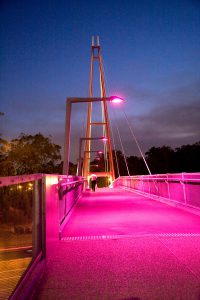
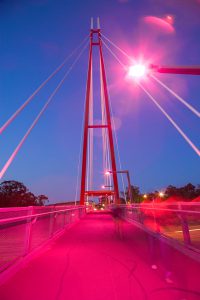
Griffith University’s iconic bridge across the Smith Street Motorway is once again spending its evenings awash in a stunning shade of pink in support of the fight against breast cancer.
Although usually a distinct shade of powerful red, the bridge has spent each October — which is also Breast Cancer Awareness Month— since 2008receiving its night-time makeover, which is made possible through the use of special pink gels placed over the lights that shine onto the structure once the sun goes down.
Driven by Griffith Business School academic and National Breast Cancer Foundation Qld Ambassador Dr Robyn Cameron, the lighting switch has become a key visual ally in continuing to raise awareness of the disease, which remains responsible for more than 13 per cent of all new cancer cases diagnosed this year.
“National Breast Cancer Foundation statistics show that breast cancer is still the most commonly diagnosed cancer in Australia,” said Dr Cameron, a two-time breast cancer survivor whose work as a social activist netted her a role as a Queen’s Baton bearer ahead of the Gold Coast 2018 Commonwealth Games in April.
“In fact, its incidence is increasing, with 1 in 8 Australian women and 1 in 700 Australian men expected to be diagnosed in their lifetime. So, it remains crucial that we not lose sight of the work to be done in combatting this disease.
“I am proud to be able to play a part in the fight for awareness and funding by making our already-stunning Smith Street bridge even more eye-catching, all month long.
“A special mention must also go to our hard-working facilities personnel, who go to great lengths and heights to put the gels on the bridge lights and ensure the campaign shines out brightly.”
Other Gold Coast businesses involved in the visual project include Pacific Fair, which will shade its distinctive ‘super roof’, and the Marina Mirage centre, which will tint its imposing sails in support.
The National Breast Cancer Foundation was established in 1994, and has since invested more than $160 million in more than 500 research projects investigating the disease. The foundation is now working towards a goal of zero deaths from breast cancer in Australia by 2030.
A recent LinkedIn report has highlighted the top five emerging jobs — and Griffith University is preparing students for these fast-growth areas with a range of innovative technology degreesto address the changing market trends.
According toEmerging Jobs: AustraliaThefastest growing jobs in the country, the top five emerging jobs are:
Customer Success Manager
Data Scientist
Full Stack Engineer
Cyber Security Specialist
Experience Designer
LinkedIn data from the last five years was used to identify the top up-and-coming roles and the skills needed for each. It looked at what roles are on the rise, where the talent has come from, and where it resides today.
Griffith is home to a suite of innovative degrees that can support students into thesefast-growthprofessions for the roles of Data Scientist and Cyber Security Specialistin particular.
The report places the role of a Data Scientist in the top 5 emerging jobs because ‘modern business is driven by data. Whether it’s financial insights or understanding customerbehaviour, people who can reason over enormous amounts of data are in high demand’.
Cyber Security Specialist makes the listbecause our ‘livesand workspaces are now digital by default. The Internet of Things further widens the digitallandscape, butexposes our data to additional hacking risks’.
Griffithcurrently offers degrees ideal that fulfil the role requirements of a CyberSecurity Specialist and a Data Scientist:
“We are starting to use social media to answer questions we have about how an environment or place is used and valued, and that’s what Data Science is all about; it’s this capacity to have access to a huge amount of data to do innovative things to answer these questions that we’ve always had,” Professor Catherine Pickering said, who is from Griffith’s School of Environment and Science.
“With so many industries and so many different disciplines it is going to be critical we’re at the cutting edge of this research and we’re really leading the world in understanding and using this, not only in data science straight but in using it in disciplines like environmental science and if you come and study this you’re going to have the skills that employers are really looking for right now.”
“Students who undertake the Bachelor of Criminology and Criminal Justice/ Bachelor of Information Technology are prepared to work in the cyber security industry with a unique set of skills,” Dr Jacqueline Drew said, who is the Program Director for the double degree.
“This degree is preparing our graduates forcybercrimejobs of the future.”
Strengtheningmidwifery education standardsto improve maternity serviceswas the call at the recent Trans-Tasman Midwifery Education conference.
Hosted by Griffith’s School of Nursing and Midwifery, the conference was held on the Gold Coast from 20-21 September and had the aim of“Transforming Midwifery Practice through Education”.
“It is important that midwifery education standards are shaped to drive best policy and practice, and the engagement of the profession through the consortium and conference is key to enabling this outcome,” said keynote speakerProfessor Mary Renfrew.
A professor of Mother and Infant Health at the University of Dundee, Professor Renfrew is a midwife, health researcher and educator and has previously worked in the Universities of York, Leeds and Oxford.
“Midwifery is a vital solution to the challenges of providing high quality maternal and newborn care for all women and infants in all countries,” she told conference delegates.
Prior to the session, Professor Renfrew also visited the Logan Community Maternity Hubs which was established early this year.
“I met some tremendous practitioners working together to build a service that really meets the needs of women and babies,” she said. “I talked with women and families and could see that there were lots of challenges – deprivation, culture, complex clinical needs, and social problems.”
Other presentations at the conference included one by Professor Roianne West who spoke about “ClosingtheGap with transformative Indigenous Midwifery Education and Practice”.
Professor West told delegates that totruly transformmidwifery practice through education and close the gap in health outcomes betweenAboriginal and Torres Strait Islander mothers and babies and other mothers and babies, we need tobecome more sophisticated in integrating Aboriginal Health philosophy and education philosophy.
To this end she proposed an integration oftransformative decolonisinglearning theories within acultural safety educational model.
Caitlin Pearson never intended to work in the charity or not-for-profit sector but her time at Griffith University played a big part in changing her philosophy.
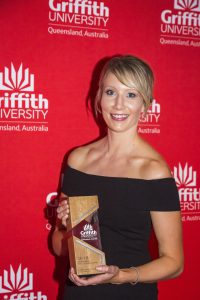
The General Manager of Marketing and Engagement at Macarthur Disability Services (MDS) is the winner of Griffith Business Schools Young Alumnus of the Year Award for 2018, and she says she is where she is today because of her time at the University.
“It’s really interesting, looking back now and I can definitely see the volunteering I was encouraged to do while at Griffith University has probably sparked that interest in doing volunteer work and getting involved at a community level,” she explains. “And I think then that sort of pushed me in this direction towards working in the charity and not-for-profit space.”
In addition to her work for MDS, Caitlin is heavily involved with charities in general, which she says is extremely important to her on both a personal and professional level. “I volunteer on a lot of charity boards, and I do a bit of work with the local council around accessibility and inclusion of people with disabilities, too.
“And I do think that’s all linked back to previous experience I had in volunteering at Griffith. It’s made me have some sort of internal feel-good connection that I wanted to continue to explore!”
Caitlin Pearson.
A typical day working for MDS— an organisation supporting more than 1000 people with disabilities and/or mental health issues, including their carers and families— sees Caitlin overseeing the planning of internal and external events and functions to raise much needed funds for the cause. “No two days are the same,” she says. “And I really feel like I am making a difference… I know that’s a cliche thing to say but I go to some of the events that I organise and I stand back and I think, “Wow there are 500 people here that are having an amazing day and an amazing experience and my work contributed to that.
“It’s really powerful, you feel like you’ve done something really worthwhile.”
In addition to her GBS Young Alumnus of the Year Award for 2018, Caitlin was also recently named CEO Magazine’s Not For Profit Executive of the Year Award in recognition of her sponsorship and branding strategy which led to MDS boosting their fundraising revenue by 50 per cent.
Having worked her way up from Junior Events Planner to General Manager of Marketing and Engagement, the Bachelor of Business graduate says many of the experiences she had while at Griffith have shaped the way she does business.
“I picked Griffith because I was really interested in a lot of the extracurricular activities and programs they had… while I was there I got to do a lot of their internships and work experience.
“I was also involved with the Honours College as well and they also pushed a lot of volunteering opportunities my way, which became really important to me.
“Already academically Griffith is amazing, but it’s those things such as the Honours College that set it apart. You get the opportunity to practise your public speaking and build your confidence and networking skills… they’re all things I use on a daily basis in my job now,” she explains.
She continues: “Whenever I tell people I studied at Griffith they are always so impressed! I’m proud to have gone to a uni with such a good reputation. I also follow what other students from Griffith are doing and I am proud to see their achievements; it’s nice to be in this big family of students that are going out and doing awesome things in the world.”
Caitlin says she was really shocked and thrilled to win the GBS Outstanding Young Alumnus Award. “I guess for me it is an acknowledgement that the work I am doing is important and valued and people see that when they see the contribution I am making to my local community. So yeah for me that’s a nice little pat on the back.”










 Captain and Bachelor of Public Relations and Communication student, Kiri Lingwood (left), issued note of caution to her charges who will take a four point advantage at the top of the table into the final round in Adelaide on October 20-21. “Every uni is hot on our tails, so we don’t want to get complacent. We’ve got a lot to work on and we’ll just focus on the first game heading into Adelaide,” she said.
 Although usually a distinct shade of powerful red, the bridge has spent each October — which is also Breast Cancer Awareness Month—