As university students transition to studying online in the wake of coronavirus, experts say there are two key activities which will make the difference between success and failure in this ‘new normal’.
Griffith Online Academic Director, Professor Nick Bartersays this sudden shift to study exclusively through computer screens rather than in-person, requires commitment but the same set of study skills.
“Online study does takes persistence, self-motivation, time management and the ability to focus in the face of a thousand distractions at home.”
“We all look for shortcuts and quick fixes in life and in most cases there aren’t any,” Professor Barter said.
“Our data analysis shows however that there are two key areas which directly correlate to grades in online studies, being Time on Task and Conversations about Content.”
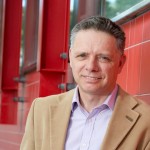
Professor Nick Barter
Professor Barter says Time on Task refers to the time spent reading, digesting and carrying out activities.
“We know that a student’s ability to, for instance, commit to time on their Learning@Griffith course site, has a correlation with the grade received.
“We believe the number of hours required to succeed in online 12-week courses doesn’t vary that much from the 12-week on-campus requirement per grade but that what is different is a students’ ability to commit to this time in a less structured environment, which means scheduling and prioritising study becomes more important than ever.
“Research also indicates that accessing the course materials online at least five times a week leads to a 92% chance of a student continuing through their course and accessing these materials less than once a week results in a higher likelihood of dropping the course (52%).
“Scheduling time to access the course sites each day to digest content is more likely to lead to success, than spending 8-10 hours in one day.”
Professor Barter says chatting on social platforms that support the course content, what he calls Conversations about Content, is the second critical determinate of success for online students.
“We learn in a social context, so following, posting and liking comments made in a synchronous chat and discussion boards allow physically distant students to connect with their content in a more meaningful way,” he explained.
“This social learning enables students to learn from the questions of others, understand other perspectives on the topic and gauge their own performance at the same time.
“There is also a strong correlation between conversation in social learning and the average grade received for the course.”
Professor Barter says if the social learning tools aren’t already in use, students should develop them.
“If a course doesn’t have a social learning platform that is working for the student, I’d suggest creating their own study group, much the same was they may have done on campus.”
The Griffith Study Planner is a useful tool to identify a students’ current commitments and allocate time required to be ‘on task’ to achieve the desired grade.
Griffith is already well advanced in online delivery, with more than 20 years delivering quality online education and offering more than 100 fully online degrees.
Forty per cent of students were already studying at least one course online through our well-established Digital campus prior to COVID-19.
Four teams of expert scientists from Griffith University’s Institute for Glycomics are targeting the virus SARS-CoV-2 to discover new vaccines and drugs to prevent or cure COVID-19.
Professor von Itzstein AO, Founder and Director of Institute for Glycomics, said that although each team possesses a specific focus and strategy, they were working closely with one another, sharing information, ideas and results, to find innovative ways to tackle the disease.
“This multi-pronged approach between highly skilled infectious diseases experts in the Institute and Queensland Health Departments, including Gold Coast University Hospital and Forensic Scientific Services, coupled with our Institute’s state-of-the-art research facilities and equipment, provides much hope in the fight against COVID-19,” Professor von Itzstein AO said.
Nobel Laureate Professor Peter Doherty AC from the Department of Microbiology and Immunology at the Doherty Institute, University of Melbourne, has been in discussion with Professor von Itzstein AO about the direction of the Institute’s COVID-19 research.
“We urgently need solutions for this disease,” Professor Doherty AC said. “Drugs to prevent or treat COVID-19 and a vaccine to prevent COVID-19 are required; and we need them now.
“The Institute for Glycomics’ integrated approach is exciting, adding to the world’s COVID-19 research efforts and I look forward to learning more of their outcomes, that will advance our knowledge, resources, and opportunities for collaboration so we can get to the end goal faster.”
Professor Mark von Itzstein AO and team
Professor von Itzstein AO and his research team including Drs Patrice Guillon, Larissa Dirr,Ben Bailly, Andrea Maggioni, Ibrahim El-Deeb and Chih-Wei Chang and other institute researchers are using advanced ex vivo (outside the body) human respiratory system models to evaluate existing drugs, and combinations, as drug candidates to prevent or treat COVID-19.
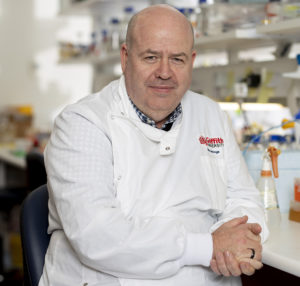
Professor Mark von Itzstein AO
The team is working in collaboration with Queensland Health Departments including Gold Coast University Hospital clinicians and Forensic Scientific Services as well as the Fraunhofer International Consortium for Anti-infective Research (iCAIR). iCAIR was established between the Institute for Glycomics and two German institutions, the Hannover Medical University and the Fraunhofer Institute for Toxicology and Experimental Medicine, in 2017.
Professor von Itzstein AO, who led the team that designed, synthesised and biological evaluated the world’s first approved designer anti-influenza drug Relenza®, said his research group’s approach to finding a cure for COVID-19 was unique in the country as the human respiratory models they employ were the closest to a real human system, without working in a human patient.
“Our approach to the rapid discovery of therapeutics against COVID-19 in collaboration with our Queensland Health collaborators and our German colleagues in iCAIR gives us the best chance to deliver a successful outcome in finding a cure against this pandemic virus. We need a cure today,” Professor von Itzstein AO said.
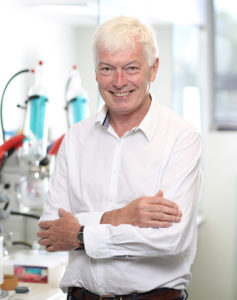
Professor Michael Good AO and team
Professor Michael Good AO and his research team are working closely with the other research teams within the Institute for Glycomics, as well as with colleagues at the Gold Coast University Hospital and China’s Olymvax Biopharmaceuticals Inc. to develop a vaccine for COVID-19.
Professor Michael Good AO
Professor Good AO, said that while he applauded the approaches being taken elsewhere in Australia and overseas to develop a vaccine, “history tells us that rarely do we strike gold on our first attempt”.
“It is important that many different approaches to developing a vaccine proceed in parallel. We simply do not have the luxury to wait on the results of one vaccine trial to see if we need to adopt a different strategy. We are optimistic that with hard work, one or more of the various approaches that we as a nation are following will be successful,” he said.
Professor Good AO and his team, based within the Institute’s Laboratory of Vaccines for the Developing World, are building on many years of vaccine development experience in streptococcus and malaria research to identify critical target points on the coronavirus that may be susceptible to immune attack and to use that information to develop a highly focussed vaccine.
“All of our combined immunological, virological and clinical expertise will be required for success, but the need for hard work will not be an impediment.
“Our country is facing a health, societal and economic upheaval, but the cause is biological, and vaccination is known to be the most cost-effective way to fight infectious agents and improve public health.”
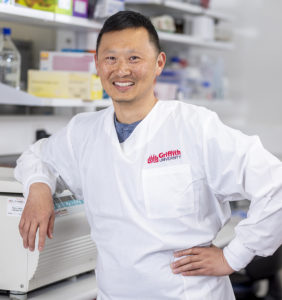
Professor Johnson Mak and team
Professor Johnson Mak and his research team are working to establish a rapid assay system to evaluate potential drug and vaccine candidates that can prevent the entry of SARS-CoV-2 (the virus that causes COVID-19). This system is currently being used in collaboration with the other research teams within the Institute for Glycomics for the development of therapeutics.
Professor Johnson Mak
Professor Johnson Mak, said that while many drug and vaccine candidates have been suggested to have therapeutic potential in the treatment of COVD-19, the relatively low number of individuals who acquire severe infection make it difficult to properly evaluate the effectiveness of all these drug and vaccine candidates in clinical trials.
“A laboratory-based evaluation system will help to filter out less-promising candidates early on, thereby enabling us to place our resources behind the most promising therapeutic strategy,” he said.
To complement this approach, the research team will work closely with Associate Professor Alan Wee-Chung Liew at Griffith Institute of Integrated Intelligent Systems and fellow Institute Research Leader Associate Professor Thomas Haselhorst in an attempt to use artificial intelligence and structural biology to fast track the development of novel antiviral drug candidates for COVID-19.
“My research team has nearly 30 years of experience in virology research. The collective expertise of our team and our collaborators, both within and external to Griffith University, will help to accelerate our efforts to identify effective therapeutic strategies,” Professor Mak said.
“We are confident that we can positively contribute to the greater global efforts to resolve the crisis situation we are currently facing.”
Professor Michael Jennings and team
Professor Michael Jennings and Dr Christopher Day have developed propriety biophysical drug screening approaches that allow for the rapid screening of known drugs that can be repurposed to target crucial steps in infectious disease processes.
Professor Michael Jennings
“These approaches, in combination with computational biology approaches led by fellow Institute Research Leader, Associate Professor Thomas Haselhorst, are currently being applied to find solutions to COVID-19,” Professor Jennings said.
State-of-the-art research facilities and capabilities
Dr Michael Batzloff, Senior Operations Manager at the Institute for Glycomics, said the facility was fully equipped to deal with the virus.
“The Institute has a number of Physical Containment Level 2 and Level 3 (PC2 and PC3) facilities. These laboratory facilities are designed in accordance with Australian standards and they allow us to conduct research on high-risk pathogens such as SARS-CoV-2.
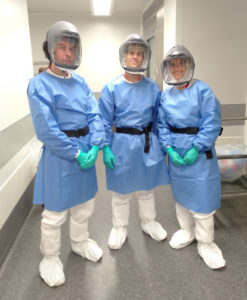
Institute researchers in Physical Containment Level 3 facility protective gear
“Access to the PC3 facility is strictly controlled and all work can be monitored remotely. These state-of-the-art facilities allow us to conduct SARS-CoV-2 research in controlled negative pressure rooms, ensuring there is no risk to staff or the environment.
“The Institute is taking all the necessary safety precautions to ensure that our vital research continues, whilst abiding by critical hygiene, safety and social distancing measures.
“Our researchers are on site to carry out essential laboratory-based activities only, whilst data analysis and other computer-based tasks will be performed remotely.”
Professor von Itzstein AO said institute researchers were working around the clock to fight the disease and, as a translational medical research institute, we are delighted to bring our virology, drug and vaccine discovery expertise to bear against this deadly virus.
“If anything, the coronavirus crisis has demonstrated just how vital our mission as a research institute is in the fight against diseases of global impact, and it’s incredibly important that our work continues even under these challenging circumstances,” he said.
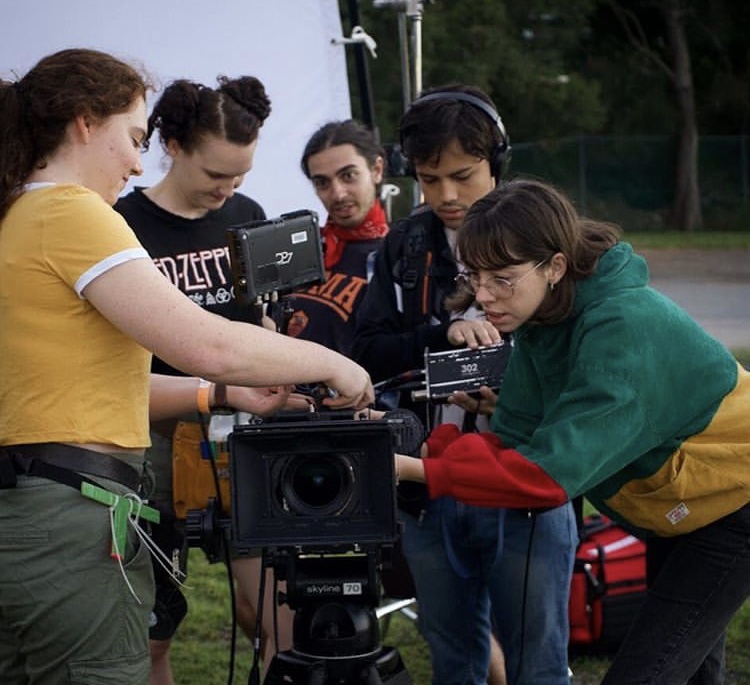
Oscar-winning filmmaker Lord David Puttnam is the driving force behind a scholarship for aspiring film producers at Griffith.
“For me, being able to do the Masters opens up a lot of opportunities, from having a network of mentors and collaborators who are plugged into the industry, to being able to access the resources and equipment to make new content,” she said.
“Winning this scholarship is a really big deal for me and it’s really inspiring to see someone in his position give back to students who are passionate about producing.”
Industry ready
The young filmmaker has taken every opportunity offered at film school, including an internship at SBS current affairs show, The Feed.
During her Masters degree, she will work with sessional lecturer and award-winning documentary producer Helen Morrison on a new project.
“I’m always looking at how to develop my career, and get as much industry experience as possible,” Kate-Marie said.
Oscar-winning producer Lord David Puttnam CBE, has a long-standing relationship with Griffith Film School. He is a regular visitor to GFS, and has also delivered a series of popular online lectures from his home in Ireland.
Global events have highlighted the importance of critical healthcare workers, from nurses at the forefront of the COVID-19 pandemic to midwives who continue to serve the community.
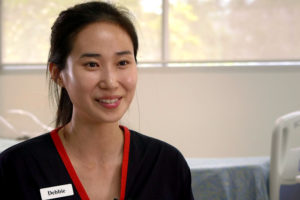
“Nursing isn’t just about caring for a person,” Hong said.
“It’s about integrating science and clinical skills and having the will to care and be passionate about helping a person.”
Deputy Head of Nursing and Midwifery at Griffith University, Thea van de Mortel said students like Debbie will have the opportunity to transform lives.
“I would often say to my students, ‘you hold peoples’ lives in your hands’,” Professor van de Mortel said.
“It really makes a difference what you do — how much you learn and apply yourself — to outcomes for people.”
“What we do individually in every interaction that we have really, really matters,” Professor Gamble said.
“When I speak to women, they go, ‘I didn’t want to say goodbye to my midwife’.”
Clinical midwife consultant, adjunct First Peoples Midwifery lecturer and Griffith alumni Cassandra Nest is the project lead on Waijungbah Jarjums, an integrated Aboriginal and Torres Strait Islander led and staffed midwifery and child health service at Gold Coast University Hospital.
“There’s a really big drive at the moment to improve health outcomes and improve the cultural capability of staff and improve the cultural safety of health services,” Nest said.
“Aboriginal and Torres Strait Islander midwives that graduate can be that change.”
The COVID-19 crisis demonstrates a growing demand for strong public accountability and the importance of whistleblower protection, according to a Griffith University public integrity expert.
Professor of public policy and law A J Brown has contributed to a global statement written in response to dramatic mistakes by officials and authorities in their knee jerk reactions to the pandemic.
The professor said the reprimand – and later death – of a doctor who tried to alert fellow doctors in China about COVID-19 in late December was a terrible yet clear outcome of the dangers caused by attempting to silence whistleblowers.
“The tragic death of Dr Li Wenliang in Wuhan, China on February 7 showed the world how vital it is for professionals to raise the alarm — but even more, how vital it is for authorities to respond properly, and not simply by shooting the messenger,” Professor Brown said.
“The local public security bureau has since apologised to Dr Li’s family, the police officers have been disciplined and more heads are set to roll over the early response to the initial outbreak in Wuhan as the Commission continues to investigate.
“Similar poor initial responses are being played out worldwide.”
Professor Brown referred to an incident which occurred on April 2 when the Trump administration stood down the US Navy captain of an nuclear aircraft carrier, for copying too many people on an internal memo appealing for faster evacuation of sick members of his 4000 crew off Guam.
He added that meanwhile last month in Poland, nurse and midwife Renata Piżanowska was sacked for posting pictures of her homemade surgical mask on social media after official calls for the public to donate personal protective equipment to hospitals. Professor Brown said officials claimed she acted “too nervously”.
At home
Professor Brown believes it is not just overseas where these incidents are occurring, with many arising on home soil too.
He cites an incident in early February when Qantas stood down an aircraft cleaner and union representative who raised concerns over cleaning standards in aircraft – a matter that is now being investigated by WorkSafe NSW.
It’s understood WorkSafe NSW issued formal breach notices to Qantas a month later for failing to provide cleaners with a safe system of work, forcing them to handle wet tissues, used face masks and dirty nappies without proper protection.
Adelaide Airport has since been brought to a near standstill by a COVID-19 outbreak among Qantas baggage handlers.
“Just yesterday, a Sydney doctor working on the COVID-19 response was forced to sound the alarm that vulnerable patients in forced hotel isolations are not getting the care they need,” Professor Brown said.
He said Australian and international research confirms that employees and officials are the single most important and fastest way wrongdoing or mistakes are brought to light in organisations — with the current crisis simply highlighting whistleblowers’ importance andstrengthened protections for private sector whistleblowers should be remembered, and where necessary, brought to bear.
“Amid strong calls for accountability to return to government decision-making at this time, we must remember it is the frontline people who speak up and speak out, who are our best assets for transparency, and most in need of our support and protection.”
“The current situation reminds us that public sector whistleblower protections are lagging behind in Australia, with law reform already overdue in the federal parliament, and many State parliaments as this crisis continues.
“This is especially the case when the risks of wrongdoing and bungling are going to apply only more strongly to the billions of taxpayers’ dollars being urgently rolled out as part of the economic response.”
Governments have previously sought to reduce climate-change inducing concentrations of carbon dioxide (CO2) in the earth’s atmosphere through mitigation and adaptation activities, but are now exploring other measures. Negative emissions technologies (NET) are aimed carbon dioxide removal (CDR) to a level consistent with a desired temperature, while solar geoengineering, also known as solar radiation management, or modification (SRM) seeks to reflect sunlight away from earth and thereby reduce global temperatures. Existing measures to combat rising emissions have not been entirely successful, and CDR and SRM have consequently gained increased policy traction in recent years. Emerging technologies include bioenergy, carbon capture and storage (BECCS) and stratospheric aerosol injection (SAI). A careful, unbiased, and knowledge-driven assessment of the risks of these technologies is required, and that robust governance systems should be put in place before they are implemented any further.
CDR was investigated in an IPCC special report in 2005. The technology was acknowledged as one of the options for removing CO2 from the atmosphere arising from the combustion of fossil fuels for energy production and the burning of forests. Solar geoengineering has emerged as a supplement to CDR as a consequence of concerns that global GHG emissions are still increasing, and may result in an increase to 1.5 degrees warming as early as 2030, which partly explains the growing interest in more radical technologies to reduce risks of climate change.
BECCS was originally envisioned only as a backstop under an extreme climate scenario should ambitious emissions reductions prove unfeasible, in the context of commensurate broad-scale forest restoration and replanting, and as a risk management option. Nonetheless the technology has gained traction because of a loophole under the Kyoto Protocol which exempted forest loss from being counted as an emission, under the accounting logic that if the cleared area regrows, or is converted to another land-use (such as agricultural crops) it continues to take up carbon. The problem with the implementation of the technology is that initial modelling and pilot projects assumed fuels would come mostly from energy crops and that if residues were used, they would all have similar emissions profiles. In reality, wood pellets are the most common energy source, and are not made from residues, but trees, with a measurably larger, and longer-term net emissions impact (NEI) than other sources. Countries have developed renewable energy policies on the basis of these prior assumptions, as was the case in the UK in 2015, where the government committed over £800 million in subsidies to biomass energy, while phasing out support for offshore wind power, and extending the life of coal-fired power stations using forests in their energy-mix, and net emissions are replacing zero emissions as a policy outcome
SRM, is a set of emerging technologies aimed at altering the Earth’s radiative balance, reducing the amount of climate change caused by greenhouse gases. Space-based techniques and stratospheric aerosol scattering have the potential to block or reflect a small portion of incoming sunlight, cooling the planet and thus reducing the risks of climate change. The leading suggested method is to mimic volcanic activity, whereby fine dust naturally lowers global temperatures for a year or two after large eruptions such as Mount Pinatubo in 1991. Another method involves spraying seawater upwards as fine droplets, which could brighten low-lying marine clouds, thereby reflecting more sunlight. This particular technology has been identified as the source for a range of popular conspiracy theories, including the belief that world governments were filling the atmosphere with toxic pollutants (‘chemtrails’). Although the injection of aerosols into the atmosphere might reduce heat stress on agricultural crops, the resulting reduction in sunlight could have other less positive impacts. Models replicating the impacts of sulfur in the atmosphere from volcanic eruptions, on which this technology are based, indicate the apparent benefits of planetary cooling are outweighed by a reduction in crop yields, while the effects on ecosystem function and human health are unknown.
Despite, or indeed, because of, the IPCC’s previous recognition of the need to give consideration to such technologies, it must continue be emphasized that the most effective approach to reducing climate change risks remains the prevention of greenhouse gas emissions in the first place, and where this is not possible, the reliable, safe and environmentally benign removal of CO2 from the atmosphere. In the case of BECCS there are issues of scale; with the appropriate feedstock and the correct energy mix of wind, solar and bioenergy, there are few adverse impacts. But if scaling up results in the destruction of the world’s remaining primary forests, or taking away land for agricultural production, scale becomes critical and the technology unfeasible. SRM might not only affect the radiation balance but atmospheric chemistry and rain patterns as well. In addition, such techniques do not address the root causes of climate change and other negative effects of high atmospheric CO2 concentrations would persist, including ocean acidification and changes to ecosystems. In other words, business as usual could continue, including the combustion of fossil fuels, while reducing some of the impacts of solar radiation through such techno-fixes, and if solar radiation management should cease as a result of economic or political crises, the result would be a rapid increase in global temperatures, as the GHGs would still be in the atmosphere.
It is the nation-states that will ultimately have to address risks posed by climate change — for good or ill. Global collaboration is key to speeding up efforts to address climate change risks; failure in co-operation, notably between the main emitting countries such as US and China, will quickly translate into a significant increase of climate change, and many more people will have to suffer than are already affected. The dangers inherent in emerging technologies are not always clear, but appropriate responses to the challenges of climate change depend very much on the careful consideration and effective implementation of any additional measures identified by the scientific community as necessary. In order to conserve human society and biodiversity, an unbiased and knowledge-driven assessment of the risks posed by engineering the climate, as well as robust governance systems, are required.
Lastly, no examination of emerging technologies for CDR and SRM is complete without recognising the risks that accompany the mitigation of, and adaptation to, climate change. These have their own inherent problems, notably around the use of market mechanisms, and other approaches that are being negotiated under the Paris Agreement. To ignore the existing tensions in the climate change debate by turning to geoengineering as a panacea could make the current climate emergency even worse.
For a full version, including references, see: Radunsky, K., & Cadman, T. (2019). Governing the Sun, The International Journal of Social Quality, 9(2), 19-34, which, due to the corona virus outbreak, is currently open source:
Klaus Radunsky, Chair, ISO TC207 SC7 Mirror Committee, Austrian Standardization Institute (ASI)
Griffith University researchers are aiming to unlock a catalytic process that will enhance the breakdown of water, into hydrogen and oxygen and bring Australia a step closer to creating clean efficient hydrogen fuel.
Australia’s National Hydrogen Strategy (2019) aims to establish Australia’s hydrogen industry as a major global player by 2030.
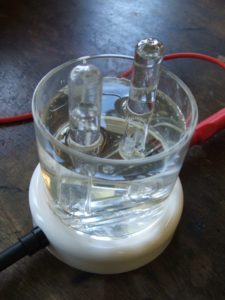
In new research published in Nature Communications, Professor Huijun Zhao and Dr Yuhai Dou from the Centre for Clean Environment and Energy are the first to fully unleash the power of CoSe2 nanobelts as an electrocatalyst for the oxidation or breakdown of water. CoSe2 nanobelts are ultrathin sheets made out of a lattice of cobalt (Co) and selenium (Se).
“The nanobelts are so small they have a thickness of about one nanometre, that’s 50,000 times smaller than the width of a human hair,’’ Dr Dou said.
“This thinness hugely increases the surface area and thus reactivity of CoSe2, as only atoms on the surface can react in a solution.”
Both ‘Iron (Fe) doping’, replacing some of the cobalt on the nanobelt with iron, and ‘Cobalt (Co) vacancy’, removing some of the cobalt, when applied individually improve the nanobelt’s ability to speed up reactions to a small degree.
The breakthrough at the Centre of Clean Environment and Energy was discovering that when both processes are put together their combined effect substantially increases the power of nanobelts to speed up reactions.
“Our discovery, that by combining these two processes we can push this catalyst to its activity limit, is very exciting. This unlocks not just the catalytic power of CoSe2 nanobelts, but catalysts for all sorts of electrochemical reaction,’’ Dr Dou said.
He said the research would advance knowledge in the fields of material science and electrochemistry.
“More importantly, with hydrogen being an essential part of the Australian government future energy strategy, this work brings Australian capability to meet the challenge of eco-friendly and efficient hydrogen production a step closer to reality.”
The ink was still drying on Denis’s last exam when he put up his hand to become a Student Investment Fund (The Fund) Foundation member, pledging $10,000 toward the program.
“I’ve seen first-hand the impact giving back can have on a community and know how much it can change people’s lives. It’s a powerful thing and I would like to start that journey,” he said.
Denis was nine years old when his parents passed away leaving him and his siblings orphans, and his 21-year-old sister the family’s legal guardian. A scholarship to attend St Joseph’s Nudgee College gave Denis the opportunity he needed to focus on his schooling.
“It put me through school and gave me the benefit of a really good education. The doors that opened for me were huge, I truly am grateful for the opportunities,” he said.
Denis had often thought about how he wanted to ‘pay it forward’ and was talking to Griffith’s Professor of Finance, Robert Bianchi, about an idea to start a not-for-profit investment fund.
“It turned out Professor Bianchi had been working on a similar idea for the past couple of years, which was about to become a real thing and they were looking for donors. I put my hand up straight away, as it was a great way to get involved,” he said.
The Fund gives eligible students the opportunity to invest in socially responsible ASX listed companies, with all Fund dividends reinvested into GBS student scholarships.
Denis was one of the first students to benefit from the real-world educational opportunities The Fund offers its students. He was also the recipient of the Karl Morris Scholarship–named after scholarship donor and fellow alumnus Karl Morris AO–giving him much-needed help when he was juggling full-time work and study.
A mature-age student, Denis had to take every opportunity to cram, making time to study on long-haul flights and in departure lounges, while traveling for work. Unfortunately, Denis ended up in hospital in the last year of his degree and recalls asking for his laptop moments after waking up from major surgery.
“The nurses thought I was crazy but I told them I have to do this,” he said.
The flexibility of online study and the ‘second to none’ support he received from Griffith were some of the many factors helping him to get through his Bachelor of Commerce degree.
“Griffith has quite innovative education tools and infrastructure, like the Trading Rooms and Bloomberg Terminals, along with the University’s ability to bring in mentors and subject matter experts.
It adds a lot of value to GBS and the finance curriculum,” he said.
Denis plans to return the favour to other students like him, who have the passion and drive to succeed and pursue a university education but need a little help to get them through.
“It’s all worthwhile. You get as much back when you give to others and sometimes a lot more. It’s very satisfying to do this and to be in a position to do so,” he said.
Not one to sit on his laurels, he is already thinking about other ways to give back.
“Giving is not just financial, it’s about your time too. I was very fortunate to have some fantastic mentors and I would like to be able to offer the same to other students. The ultimate prize is to move from a life that is successful to a life that is meaningful to others,” he said.
“I have heard a saying that goes something like, ‘we make a living by what we get but we make a life by what we give.’ The impact you can have on others is something I have seen through my own eyes, it’s a powerful thing and I want to start that journey.”
It has been two decades since the late Humphrey Firkins DUniv established The Goda Foundation in loving memory of his wife, Goda.
In that time, the foundation has flourished, shifting its philanthropic focus from supporting local Gold Coast high school students to higher educational institutions, including Griffith University.
Griffith University’s Pro Vice Chancellor (Health) Professor Sheena Reilly said the foundation’s support had been invaluable in helping to advance Alzheimer’s disease and dementia research, as well as education.
“The foundation’s very generous PhD scholarships help create pathways for research students to contribute to a body of work attempting to tackle some of the biggest health challenges facing our community,” she said.
“Thanks to their generosity, early career researchers have the opportunity to explore potential treatments and cures for Alzheimer’s disease, dementia and many other debilitating illnesses.”
The foundation first connected with Griffith about 10 years ago and has maintained a close relationship with the University ever since.
Griffith Health’s Professor Allan Cripps AO worked closely with the foundation at the time and developed a close relationship with Humphrey Firkins.
“Humphrey’s desire to help others and his belief in the value of education was powerful. He was totally focused on giving young people the opportunity to meet their potential and make a full contribution to society,” Professor Cripps AO said.
Through the Foundation, the University developed educational programs for Queensland school students including Science on the GO! and the Science Experience. It also initiated the Goda Foundation PhD Scholarships–a program for higher degree research students researching Alzheimer’s disease, dementia, genomics, cancer and cardiovascular diseases.
“Humphrey’s vision was to develop a body of knowledge in the field of Alzheimer’s disease and dementia research that could be used to understand the disease and develop interventions to treat and cure patients. He would have been over the moon if he had lived to see a cure,” Professor Cripps AO said.
Working under the ethos that ‘education transform lives,’ the foundation has carried on the legacy of its founder, expanding its network of giving under the leadership of Peter Firkins, one of Humphrey and Goda’s three sons.
Mr Firkins explained the Foundation’s focus on medical research, particularly in the area of Alzheimer’s disease and dementia, was driven by his mother’s illness from Alzheimer’s disease.
“During Goda’s illness it was very apparent there was a vast amount of research needed to improve knowledge, not only in treatment but also prevention,” he said.
“The Foundation hopes research funding will contribute to the improvement of outcomes for people who suffer terribly from the effects of Alzheimer’s and related diseases. Without support there is no advancement.”
Like many Queensland Conservatorium graduates, Sam, 21, is looking to the future, and as an aspiring professional violinist, dreams of playing for one of the great symphony orchestras.
“I really enjoy playing in an orchestra and love playing with other musicians. It’s nice to share an experience with someone else while they’re playing with you. Sharing music with others is my favourite way to play,” she said.
The power of the collective has reverberated in Sam’s music in other ways too.
The inaugural recipient of The Arts Assets Giving Circle scholarship, established through a group of friends, Sam can confidently pursue a career in music after graduation.
“It is a big deal, I have never received something like this before. This scholarship is going to do so much for me and students like me who are here [Queensland Conservatorium] by the skin of their teeth,” she said.
A gifted musician, Sam started learning to play the violin at the age of eight, dedicating countless hours to fine tuning her craft.
Her mother had first encouraged Sam to learn the piano, but Sam soon took up the violin after watching her brother play.
“I saw my older brother playing violin and he loved it, and I wanted to play too,” she said.
Having two talented violinists in the family was probably more than Sam’s parents had bargained for, with Sam’s brother studying at the Royal Danish Academy in Copenhagen in Denmark and Sam at the Queensland Conservatorium.
Although Sam lived a little closer to her hometown of Sydney, the cost of relocation, living expenses and a suitable violin for someone of Sam’s calibre were exorbitant.
“It’s very expensive, my parents have done so much for us and have been very supportive,” she said.
Between music lessons, multiple violins and ongoing maintenance costs, Sam was fortunate to stave off the further expense of a new violin at the standard required for university.
On loan from the University’s Instrument Bank, Sam has been playing the Victor Licciardi Violin, which was generously donated.
The much-loved instrument is something Sam has treasured throughout her degree and has played a huge part in taking her to the next level of her practice.
The violin belonged to Queensland Symphony Orchestra violinist, Victor Licciardi. The only condition of the loan was the instrument be wrapped in the same silk scarf he had used when storing it for safe keeping.
Sam returned the violin at her last recital at Griffith, forming part of an ongoing legacy that ensures future generations of young violinists have access to quality instruments.
“It is such a beautiful instrument and has helped me so much, I will be sad to see it go but it’s for the best because it is in the spirit of how it was given and will go on to help other students,” she said.
The next violin Sam will own will most likely be her ‘forever violin’ something she will need if she is to take her career to the next level.
The savings she has scraped together from part-time work and the scholarship will go a long way to making that next crucial step.
“I’m so grateful for the support. The money has helped me plan and imagine myself doing things I didn’t think I would be able to do before,” she said.
“It makes such a big difference to a person like me, it means I can look at further study or buy a violin, which would be the biggest deal for me right now.”
Sam recalls meeting the scholarship donors after performing the Korngold Violin Concerto with the Conservatorium Symphony Orchestra.
“They were all so lovely and supportive. It was nice they got to see me play and put a face to the person on the paper,” she said.
Dr Sheena Burnell first floated the idea of creating the scholarship by forming a giving circle. Collectively, their combined resources enabled them to establish the scholarship.
“The people who ended up chipping in were people I just happened to be chatting with at work, and they were like, ‘I want to be in on that,’ it was really wonderful.
“We wouldn’t necessarily all meet each other socially but this scholarship brought us together. It just seemed like a good idea and has been really fun.
“What made it all worthwhile was when we met Sam and saw her perform. She is such a worthy recipient, I hope we can follow her whole career.”
Dr Burnell has been a music lover for many years and wanted to do more to support the arts culture in Brisbane. She saw philanthropy as an opportunity to help.
“If I had more money, I would give more. I’m very much about service, it’s something I enjoy,” she said.
“I think philanthropy is a measure of a society, I’ve always been a great believer in a society that helps others.
“If you have means, you should share it around. For me, a vital and vibrant arts scene is really important for an intelligent thriving society.”

 “Scheduling time to access the course sites each day to digest content is more likely to lead to success, than spending 8-10 hours in one day.”
 The Griffith Study Planner is a useful tool to identify a students’ current commitments and allocate time required to be ‘on task’ to achieve the desired grade.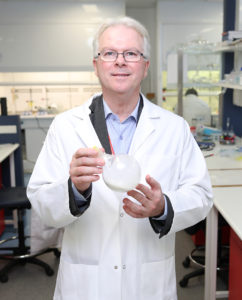


 On
On 
 “The tragic death of Dr Li Wenliang in Wuhan, China on February 7 showed the world how vital it is for professionals to raise the alarm — but even more, how vital it is for authorities to respond properly, and not simply by shooting the messenger,” Professor Brown said.
 In new research published in Nature Communications, Professor Huijun Zhao and Dr Yuhai Dou from the Centre for Clean Environment and Energy are the first to fully unleash the power of CoSe2 nanobelts as an electrocatalyst for the oxidation or breakdown of water. CoSe2 nanobelts are ultrathin sheets made out of a lattice of cobalt (Co) and selenium (Se).